



Start Designing for Free!
By Bliss & Bone
May 2026
The average engagement length in the US is 15 months, according to The Knot's 2026 Real Weddings Study, which surveyed 10,474 couples who married in 2025. That number has held steady since 2022, surviving the post-pandemic boom, three years of inflation, and Gen Z's rise to 41% of the wedding market. About 40% of US couples spend 11 to 18 months engaged. The rest spread across a wider tail: some plan in under six months, others stretch their engagement past two years to manage budgets, venue waitlists, or career timing. The average is real, but it hides a lot of variation by country, age, and what stage of planning a couple is actually in.
Internal data from 15,000 weddings on Bliss & Bone tells a different version of the same story. The median US couple starts building their wedding website 8.4 months before the wedding date, which means a typical American spends nearly half of their 15-month engagement before they actively begin assembling vendors and digital tools. The headline number is a survey average. The behavior behind it is messier, and more useful.
The most recent data point: The Knot's 2026 Real Weddings Study, fielded across 2025 weddings, puts the average length of an engagement in the US at 15 months. The study has run annually for nearly two decades and is the largest of its kind, capturing self-reported data from a 10,474-couple sample. Roughly 40% of couples reported engagement lengths between 11 and 18 months, which is the modal range and the one most wedding industry timelines are built around.
The 15-month average masks a wide distribution. Short engagements (under six months) are common among second marriages, elopements, and couples who already lived together for years before the proposal. Long engagements (24 months or more) usually reflect either a specific venue waitlist, an international wedding, a school-or-career timing constraint, or, increasingly, budget pacing as costs continue to climb. The 2025 average US wedding cost reached $33,000, with Northeast and Mid-Atlantic markets pushing past $46,000.
For the simplest practical takeaway: a 15-month engagement is normal, a 12-month engagement is normal, and an 18-month engagement is normal. Anything inside that ~6-month window around the average is statistically unremarkable. Engagements significantly shorter or longer than that band reflect specific personal logistics, not a national norm.
The 15-month figure has been stable for three straight years, but the trend line just before that was unusually volatile. The average length of engagement in the US ran at 14 months in 2019, 15 in 2020, and 16 in 2021, before settling back to 15 months in 2022 and holding there through the 2026 study. The 2021 peak is the COVID artifact: couples who postponed their original 2020 weddings ended up with engagements averaging 24 months, dragging the national mean up by a full month.
What's more telling is what didn't happen after the post-pandemic catch-up. By 2022 the rebooked-wedding backlog had largely cleared, and the average could have snapped back to its pre-pandemic 14-month baseline. Instead it held at 15. The reason is structural: weddings have gotten more expensive every year since, venue inventory in the most desirable markets remains booked 12 to 18 months out for peak Saturdays, and couples are entering their engagements at older ages (median age of marriage in the US is now 32, up from 29 a decade ago). Each of those factors pushes engagements longer.
The clean read: the average length of engagement before marriage in the US has structurally moved up by about one month in five years, and the pandemic accelerated rather than created that shift. Don't expect it to fall back. Expect the next move to be another tick upward if inflation in venue and vendor pricing continues.
The 15-month US average is roughly the global median for English-speaking wedding markets, but the spread across countries is significant. The UK runs essentially identical to the US, with couples engaged for an average of 15 to 16 months. Canada sits just below at around 14 months. Australia is the major outlier: Easy Weddings' 2025 Australian Wedding Industry Report puts the average Australian engagement at 24 months, up from a stable 21 to 22 months in prior years, with the report attributing 30% of long Australian engagements specifically to budget pacing.
Bliss & Bone's own platform data, drawn from 15,000 weddings across the four largest English-speaking markets, surfaces a useful inverse pattern. The median time a couple spends actively planning on the platform (from website creation to wedding date) runs 8.4 months in the US, 7.5 months in the UK, 7.0 months in Australia, and 6.3 months in Canada. So even though Australian couples have the longest engagements on average, they have the second-shortest active planning window. The implication: Australian couples sit on a long passive engagement (engagement party, venue scouting, savings) before flipping into the active planning phase, while Canadians compress almost their entire engagement into focused execution.
What matters more than the country average is where in the engagement a given couple actually sits. A US couple at month 7 of a 15-month engagement is about to start building. A Canadian couple at month 7 of a 14-month engagement is already most of the way through their active planning. Same headline engagement length, very different operating state.
Age explains more of the variation in engagement length than any other demographic input. Younger couples (sub-28) tend to run shorter engagements, often in the 9 to 12-month range, because they're more likely to be planning simpler events, working with smaller budgets, and less likely to have venue requirements that compete with a 12-month booking calendar. Couples in their thirties skew toward the 15-to-18-month average and beyond, driven by higher household incomes, more elaborate vendor lists, and a stronger preference for destination or peak-season venues that book a year-plus in advance.
Regional variation in the US tracks closely with cost of marriage and average marrying age. The Northeast, Mid-Atlantic, and West have the highest average marrying ages and the most expensive wedding markets (New England weddings average $46,600; Mid-Atlantic averages $48,400), which correlates with engagements running at or above the 15-month national average. The South and Southeast skew younger (lower median marriage age) and tend to produce slightly shorter engagements, often closer to the 12-to-14-month range, with religious-tradition weddings sometimes pulling shorter still.
There's also a clear behavioral split by month of proposal. December is overwhelmingly the most concentrated proposal month globally, accounting for between 11.6% and 16.3% of all Bliss & Bone signups depending on country. A couple engaged in December targeting a peak Saturday in May or June of the following year is mechanically locked into a 17-to-18-month engagement. A couple engaged in February with the same target date gets a 15-to-16-month engagement. Proposal seasonality alone produces measurable variation in average engagement length.
This is where the 15-month figure gets interesting, because the engagement is rarely 15 months of active wedding planning. Bliss & Bone's platform data, which captures the moment a couple first starts building their wedding website (a credible proxy for the start of active digital planning), shows a US median lead time of 8.4 months. The interquartile range is tight: 25% of couples start at 5.8 months out, 75% are started by 11.0 months. That places almost the entire active planning window inside the back half of the average engagement. For the full breakdown of that window by wedding type, country, and short-timeline scenario, see how long it actually takes to plan a wedding.
Backing into the math, the typical US couple spends roughly 6.6 months in what's best described as passive engagement before flipping into active planning. The first months tend to be: announcing to family and inner circle, deciding rough budget and guest count, narrowing a venue shortlist, and securing the venue itself, which then locks the wedding date and triggers the cascade of vendor decisions. The Bliss & Bone lead time is the moment that cascade begins.
Country-by-country, the passive engagement phase varies meaningfully. US couples are passive for about 6.6 months (15 – 8.4). UK couples for about 8 months (15.5 – 7.5). Canadian couples for roughly 7.7 months (14 – 6.3). Australian couples for an unusually long 17 months (24 – 7.0), reflecting both the longer overall engagement and the Australian habit of celebrating the engagement itself as a multi-month social event before formal planning starts. This is the data point that breaks the "couples plan their wedding right after the proposal" narrative cleanly. For every country in the dataset, the answer is no, they don't. They wait roughly half their engagement before formal planning starts in earnest.
The practical reading for couples currently engaged: if you're at month 6 of a 15-month engagement and just starting to feel urgency, that's exactly when the median couple steps in. You're on time. If you're at month 3 and ready to build a wedding website and lock vendors, you're ahead of 75% of couples. If you're at month 11 and just starting, you're on the back end of the curve but still inside the normal distribution, especially for shorter engagements driven by venue cancellations or proposal-to-wedding deadlines.
The 15-month average sits between two structurally different couple profiles, and understanding both is what gives the headline number context.
The short end (under 9 months) is dominated by three groups. Second marriages tend to run shorter engagements because couples already know each other's families, have established living arrangements, and don't need the full social runway of a first wedding. Elopements and microweddings, now a meaningful share of the market, can be planned in under three months when the vendor list collapses to officiant, photographer, and venue. And couples with religious or cultural traditions that compress the planning window (some Catholic, Hindu, and Orthodox Jewish weddings) often plan to a faster timeline by design. Notably, Dave Ramsey's frequently cited "6-month engagement" recommendation, drawn from financial pacing logic, lands squarely in this short-end cluster.
The long end (24+ months) is dominated by venue-driven and budget-driven couples. The single biggest cause of a 24-month engagement is a specific desired venue booked out two years for the preferred date, which is now standard for top-tier urban and destination venues. Budget pacing is the second major driver: a couple targeting a $60,000 wedding with $30,000 in current savings will often extend their engagement by 6 to 9 months specifically to bank the rest. Destination weddings, which represent 33% of Bliss & Bone's customer base, tend to run longer because logistics involve guest travel coordination and overseas vendor sourcing. International destination weddings in Italy, Mexico, France, Greece, and Portugal alone account for the bulk of the destination cohort.
There's also a research thread connecting engagement length, dating length, and marriage longevity. Emory University's frequently cited 3,000-couple study found that couples who dated for three or more years before getting engaged showed a 50% lower likelihood of divorce, with one-to-two-year dating windows producing a 20% reduction. The study controlled for wealth and education and is specifically about pre-engagement time, not engagement length itself. The corresponding research on engagement length alone is thinner, with most analysis pointing to a relatively wide "safe zone" between roughly 9 and 24 months, where engagement duration appears to have minimal independent effect on marriage longevity. Outside that band (very short or very long), confounding variables tend to do the explaining.
In the United States, the average length of an engagement is 15 months, based on The Knot's 2026 Real Weddings Study of 10,474 couples married in 2025. About 40% of US couples are engaged for 11 to 18 months. Engagements outside that range are common but reflect specific circumstances like venue waitlists, budget pacing, or short-engagement second marriages and elopements.
Yes, slightly. The US average ran at 14 months in 2019, rose to 16 months in 2021 during the pandemic backlog, and has now held at 15 months for four consecutive years. The structural shift up from 14 to 15 months reflects older marriage ages (median is now 32), rising wedding costs, and tighter venue availability in major markets. The pre-pandemic 14-month baseline is unlikely to return.
The US (15 months) and the UK (15 to 16 months) run essentially identical averages. Canada is slightly shorter at around 14 months. Australia is the major outlier at 24 months, according to the Easy Weddings 2025 Australian Wedding Industry Report. Within Bliss & Bone's platform of 15,000 weddings, Australian couples also exhibit the longest gap between engagement and active wedding planning, suggesting a longer cultural runway before formal planning begins.
A 6-month engagement is shorter than the US average but well within the normal range, especially for second marriages, elopements, smaller weddings, and couples without venue constraints. Dave Ramsey has popularized the 6-month engagement as a financial-discipline recommendation, and there is no research showing engagement lengths in the 6-to-12-month range are associated with worse marriage outcomes. The practical constraint is vendor availability: many photographers, venues, and bands book 9 to 12 months ahead, particularly for peak season Saturdays.
A 24-month engagement is longer than the US average but increasingly common, particularly among couples targeting in-demand venues, destination weddings, or pacing toward a higher budget. Australian couples average right at 24 months. The Emory University dating-and-marriage-longevity research, often cited in this context, addresses dating length before engagement, not engagement length itself. Two-year engagements have no documented association with worse outcomes.
According to Bliss & Bone's platform data from 15,000 weddings, the median US couple begins building their wedding website 8.4 months before the wedding date, which means they're starting roughly 6 to 7 months after getting engaged. The interquartile range is 5.8 to 11.0 months of lead time. Active wedding planning typically begins in the back half of the engagement, after the venue is locked and the date is set.
Most published research on marriage longevity focuses on pre-engagement dating length, not engagement length itself. The Emory University study of 3,000 couples found that couples who dated three or more years before engagement had a 50% lower likelihood of divorce, controlling for income and education. Direct research on engagement duration alone shows minimal independent effect within the typical 9-to-24-month range. Outside that band, confounding factors (very rushed marriages, very delayed marriages) tend to explain most of the variation.
There is no single right answer, but the practical anchor points are: vendor and venue availability for your preferred date, your savings rate against budget, the complexity of your guest list and logistics (destination, multi-day events), and any personal timing constraints. Most couples land somewhere between 12 and 18 months because that's the window that aligns with venue booking calendars and gives enough runway to save, design, and coordinate without becoming a multi-year project.
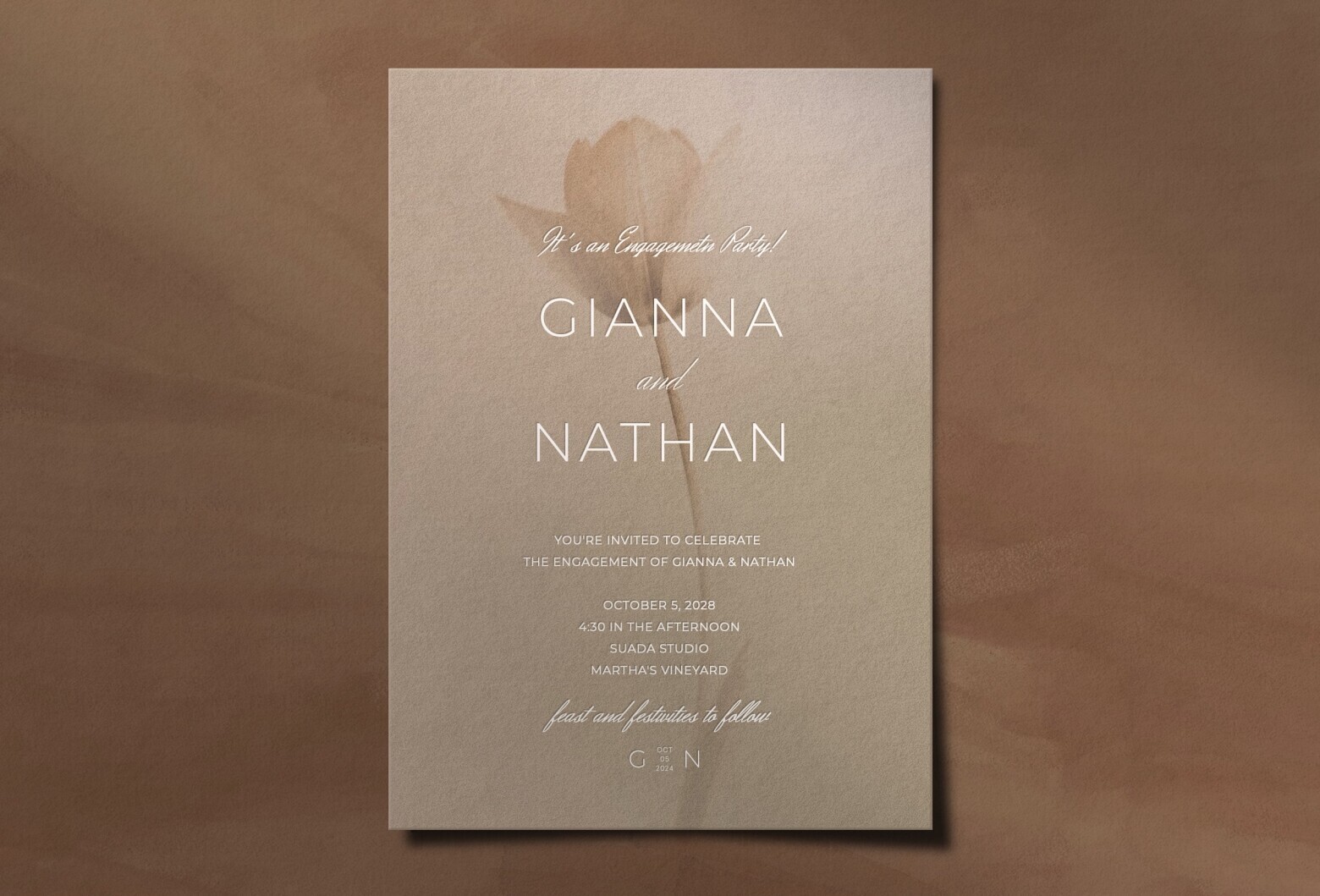
Whatever length your engagement ends up being, the first piece of stationery most couples send is an engagement party invitation, often within the first month after the proposal. Every one of our online wedding invitations can be edited and rewritten as an engagement party invitation in a few minutes, so the same design language carries from your earliest announcement through the wedding day itself.