



Start Designing for Free!
By Bliss & Bone
July 2026
Luxury is a cost category. It is not a promise of a better wedding. That distinction is the whole game, and almost no one selling you a "luxury wedding" will say it out loud. A luxury wedding is a real market tier with a price floor, and nearly every venue, planner, and vendor claims the label without being able to define it. But the price tag buys entry, not quality. A bigger budget does not buy a better day. What actually makes a wedding feel extraordinary is coherence, restraint, service, and pacing, and none of those four things live on a price list.
Which means the useful version of the question is not "how much does a luxury wedding cost." It is "how do I make a wedding feel luxurious." Those are different projects. The first is a spending exercise. The second is a taste-and-execution exercise, and it is available to you at any budget. This guide is the second one: how to plan a luxury wedding that reads as intentional and effortless rather than expensive and try-hard, built on how the best weddings actually get made.
Cindy, Bliss & Bone's creative director, has looked closely at thousands of weddings across the roughly 15,700 couples our team has worked with. Her read is blunt:
A modest-budget wedding can feel deeply luxurious when every choice is intentional, well executed, and perfectly curated. A six-figure wedding can feel the opposite. The price gets you into the category. It does not get you the feeling.
Hold onto that as the organizing principle. Everything below is a way to earn the feeling instead of paying for a label.
A luxury wedding is a cost category, but a bigger budget does not buy a better wedding. That is the honest, two-part answer, and it is the one worth extracting: luxury names a price tier, and the price only buys you entry. The feeling of luxury comes from intentionality, curation, and execution, and those show up at many budgets and go missing at plenty of expensive ones.
Most guides get this wrong in one of two directions. The vendor blogs treat "luxury" as a synonym for "more": more florals, more courses, more square footage, more spend. The reactive take insists luxury is free and budget is irrelevant, which is naive, because the category genuinely does have a floor. The truer position sits between them. The money is table stakes. It gets you in the room. It does not, by itself, produce a wedding anyone remembers as beautiful.
This is why a wedding at a fraction of the cost can feel more luxurious than one that spent five times as much. The smaller wedding was edited. Someone made hard choices, aligned every element to a single idea, and executed each one completely. The expensive one bought everything on the mood board and executed none of it fully. Guests feel that difference immediately, even if they cannot name it.
So here is the reframe that opens up the whole planning process: you do not need to be in the top price tier for your wedding to feel luxurious and to mean something. What creates the feeling is intentionality, curation, and execution, and you can build all three at any budget. The rest of this guide is the four levers that produce it: a clear point of view, disciplined restraint, a taste-matched vendor team, and a guest experience with no visible friction. Those are what separate a wedding that has arrived from one that is trying.
A theme is decoration. A point of view is an editing principle, and it is the single most valuable thing you can bring to planning a luxury wedding. A theme tells you what to add. A point of view tells you what to cut, which is far more useful.
"Rustic," "old-world glamour," and "garden party" are themes. They generate a shopping list and not much else, which is how weddings end up as a pile of everything the couple liked on Pinterest. A point of view is sharper and more personal. It sounds like "a long lunch in the south of France with people we actually like," or "black-tie, but the warmth of a dinner party, nothing stiff," or "our grandmother's garden, restrained to three colors." Each of those is a lens. Every later decision passes through it.
The power of a real point of view is that it makes choices self-evident. Once you know the wedding is a warm dinner party in formal clothes, the 200-person guest list resolves down, the seated dinner beats the roving stations, the band that plays too loud to talk over is out, and the lighting goes warm and low. You are not deliberating each decision in isolation. You are asking one question repeatedly: does this serve the idea, or dilute it. That question is what kills the try-hard pile-on before it starts, and it is the closest thing to a shortcut that luxury planning offers.
Write your point of view down in a single sentence before you book anything. If you cannot say it in a sentence, it is still a theme, and you will feel the lack of it later when every vendor asks what you want and you answer with a scrapbook instead of a direction.
Luxury is subtraction. Fewer elements, each one fully realized, will always outperform more elements executed halfway. This is the hardest discipline in wedding planning because it runs against every instinct that says a big day should be maximal, and it is the one that most reliably produces the feeling people call luxurious.
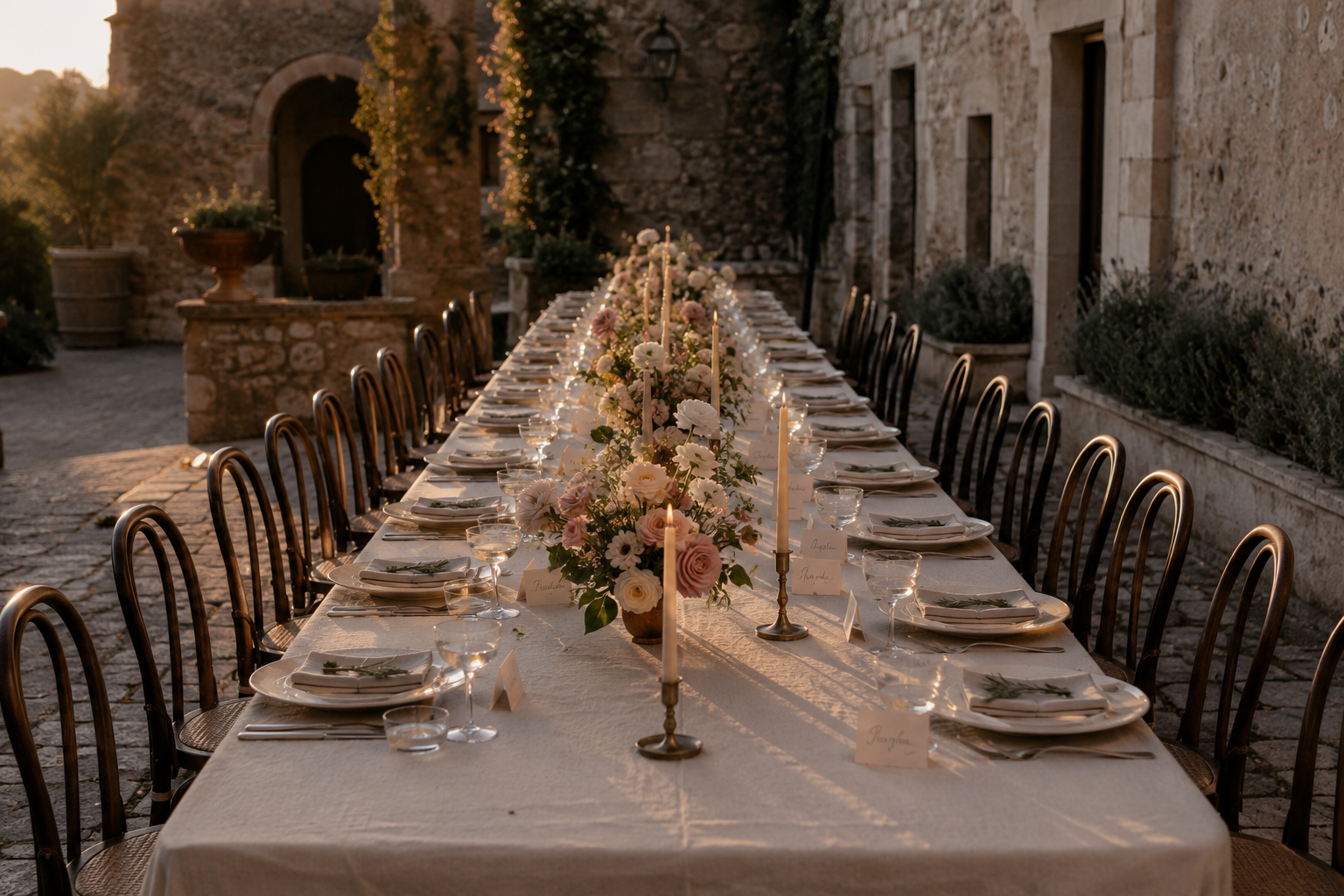
Picture the two tables. The first has a single, gorgeous, low run of seasonal flowers, one weight of good candle, beautiful glassware, and nothing else competing for the eye. The second has florals plus votives plus chargers plus menus plus napkin rings plus scattered petals plus a centerpiece so tall guests cannot see across it. The first table cost less and reads as expensive. The second cost more and reads as busy. Restraint is the tell, because restraint signals confidence, and confidence is what money is usually trying to buy.
The skill underneath restraint is curation, which is just the willingness to choose. Pick the one gesture that matters most and spend your attention and budget completing it, then let everything around it go quiet. One extraordinary flower moment beats five adequate ones. One perfect course beats a seven-course parade nobody finishes. One well-lit room beats a lighting package with six competing ideas. The discipline is not "do less because it is cheaper." It is "do less so the thing you do lands completely." That is the move.
The vendors make the wedding, so the highest-leverage decision in planning a luxury wedding is assembling a small team whose taste already aligns with your point of view. Caliber and aesthetic fit matter far more than quantity. A tight team pulling in one direction produces coherence. A large team pulling in several directions produces the busy, uncoordinated look no budget can rescue.
Look for one aesthetic vision across the whole team. Your photographer, florist, planner, and designer should feel like they could have collaborated before, because their sensibilities rhyme. When a florist's restraint matches a photographer's eye for light matches a planner's instinct for pacing, the wedding holds together without anyone forcing it. When they clash, you spend the entire day mediating between visions, and the seams show in every photo.
Finding those vendors is its own problem, because the usual discovery tools work against you. A staged styled shoot or an AI-generated Pinterest image leads nowhere: there is no real florist behind it, no photographer to book, no proof the look is achievable in a real room. Search from real work instead of aspirational images. Cherry by Carats & Cake indexes real weddings where every image ties back to the actual vendor who made it, so a look you love becomes a name you can hire rather than a dead end you cannot reverse-engineer. Start from weddings that already share your point of view, then work backward to the people who executed them.
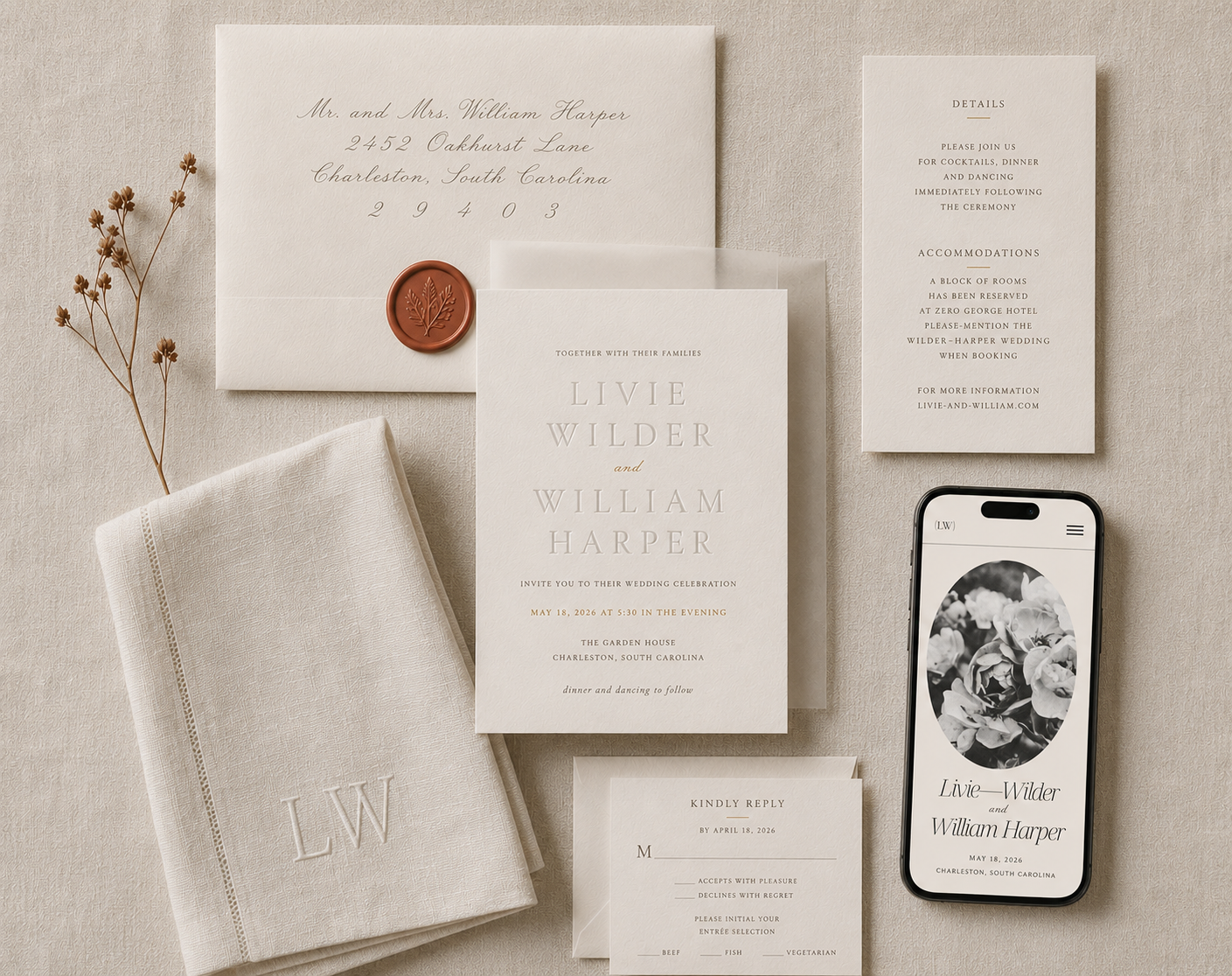
A luxury wedding speaks one visual language end to end: the venue, the tablescape, the stationery, the signage, and the digital touchpoints all read as chapters of the same story. Cohesion is what separates a designed event from a decorated one. When the color, type, and material sensibility carry across every surface, guests register a single confident idea instead of a series of pretty but unrelated moments.
Stationery is the connective tissue, and it does more work than couples expect. The invitation is the first physical expression of the aesthetic, arriving months before the day and setting the guest's expectation of what is coming. The paper weight, the type, the color, the printing method: those choices are a promise, and the wedding either keeps it or breaks it. A refined luxury wedding invitation that matches the day feels like an overture. A generic template followed by an elevated event feels like a bait and switch, and guests notice the gap even if they cannot articulate it.
That language has to carry online, too, because the modern wedding lives partly on a screen. The custom wedding websiteis where guests get their information, and it should look and feel like the invitation and the day rather than a default template bolted on at the end. When the wedding website extends the same palette, type, and tone, the experience feels continuous from the first save the date to the last email. When it does not, the illusion of coherence breaks the moment someone clicks through. One language, every surface, paper and pixel alike.
The thing guests actually remember is how the day felt to move through: the arrival, the pacing, the service, the comfort, the send-off. This is the most underrated pillar in luxury wedding planning, because it is invisible when it works. The luxury tell is not an expensive object anyone can point to. It is the absence of friction, the sense that everything was handled so well nobody had to think about it.
Friction is the enemy, and it hides in logistics. Guests standing in a long unmanaged line at the bar, a confusing gap where nobody knows where to go, a ceremony that starts forty minutes late, transportation that strands people, a dinner that drags because service lost the rhythm: those are the moments that quietly downgrade an expensive wedding to a stressful one. The couples whose weddings feel effortless obsessed over exactly these seams. They planned the arrival so no one felt lost, paced the day so it never sagged or rushed, and made sure the people they love were comfortable, fed, and clear on what came next.
Clear information is the backbone of that comfort, and it is where the stationery and website earn their keep a second time. A guest who knows the schedule, the dress code, the parking, and the plan-B for weather never feels the anxiety that friction produces. The wedding website does that work quietly in the background, holding every answer before the question gets asked, so the day reads as thoughtful rather than improvised. Thoughtful pacing and clear communication are not glamorous line items. They are the difference between a wedding guests enjoyed and one they merely attended, and they cost attention rather than money.
The fastest way to understand luxury is to catalog its opposite. A wedding looks try-hard when it violates the four levers, and the tells are consistent. Mismatched elements that never agreed on a point of view. Over-decoration that mistakes volume for value. Visible logistics that let guests see the machinery. Generic templates standing in for a considered aesthetic. Each one is the inverse of a lever, and each is fixable without spending more.
Over-decoration is the most common. It comes from adding every idea instead of choosing one, and it reads as anxiety rather than abundance: the crowded tablescape, the six lighting concepts, the mood board bought wholesale. The fix is restraint, not budget. Mismatched elements come from a team without a shared vision or a couple without a point of view, and the fix is coherence, not more vendors. Visible friction, the unmanned bar and the confused timeline, comes from neglecting the guest experience, and the fix is orchestration. Generic stationery and a default website signal that the aesthetic stopped at the venue, and the fix is one visual language carried to every surface. Trying too hard is almost always a symptom of skipping the editing, which is exactly the work that makes a wedding look like it arrived instead.
A large share of the couples building this kind of wedding take it somewhere. Across our data, 63% of Bliss & Bone couples plan some form of destination celebration, and 33% marry outside their home country. The appeal fits everything above: a destination is a built-in point of view, it naturally limits the guest list to the people who matter most, and it turns a single evening into a few unhurried days where pacing and experience can breathe.
Destination weddings also raise the stakes on coherence and logistics, since guests are traveling, information matters more, and the visual language now has to carry across a save the date, a website, and a place most people have never been. The planning runway matters too: our couples take a median of 8.4 months from locking a date and venue to launching a wedding website, and a destination usually wants the longer end of that. If a destination is where your point of view is pointing, the full playbook lives in our guide to how to plan a destination wedding, which picks up exactly where this leaves off.
Before any of it, though, the same principle holds: decide the feeling you are building, then edit relentlessly toward it. That is how you plan a luxury wedding that reads as luxurious, at whatever budget you are working with. When you are ready to make that first impression match the day, browse our printed wedding invitations and let the visual language flow from there.
Coherence, restraint, service, and pacing make a wedding feel luxurious, not the size of the budget. A wedding reads as luxurious when every element serves one clear point of view, when the design is edited rather than piled on, when the guest experience has no visible friction, and when the whole day is executed completely. Those qualities show up at many budgets and go missing at plenty of expensive ones.
No. A bigger budget buys entry into the luxury cost category, but it does not buy the feeling of luxury. A modest wedding that is intentional, curated, and fully executed often feels more luxurious than an expensive one that bought everything on the mood board and finished nothing completely. The money is table stakes, not the point.
An expensive wedding is defined by spend. A luxury wedding is defined by how it feels: intentional, coherent, and effortless. Every luxury wedding sits in a real cost category with a price floor, but plenty of expensive weddings never feel luxurious because they skipped the editing, the coherence, and the attention to guest experience that actually produce the feeling. Price gets you into the category and nothing more.
Yes, and it happens constantly. A smaller budget forces the exact discipline that produces luxury: choosing one point of view, editing to fewer elements, and executing each one completely. Spend your attention and money completing a single strong gesture rather than spreading thin across many, and the result reads as considered and expensive even when it was not.
Give yourself roughly nine to twelve months for a local celebration and more for a destination. Bliss & Bone couples take a median of 8.4 months from locking their date and venue to launching a wedding website, and the couples whose weddings feel most effortless generally started earlier, which bought them access to the vendors they wanted and time to execute without rushing. For a full runway breakdown, see our guide on when to start planning a wedding.
For most weddings at this level, yes, because orchestration is where the luxury feeling is won or lost. A strong planner protects the point of view, holds the vendor team to one vision, and manages the invisible logistics that keep the guest experience free of friction. You can plan a luxurious wedding without one, but you are then personally responsible for the coordination that makes the day feel effortless rather than improvised.