



Start Designing for Free!
By Bliss & Bone
July 2026
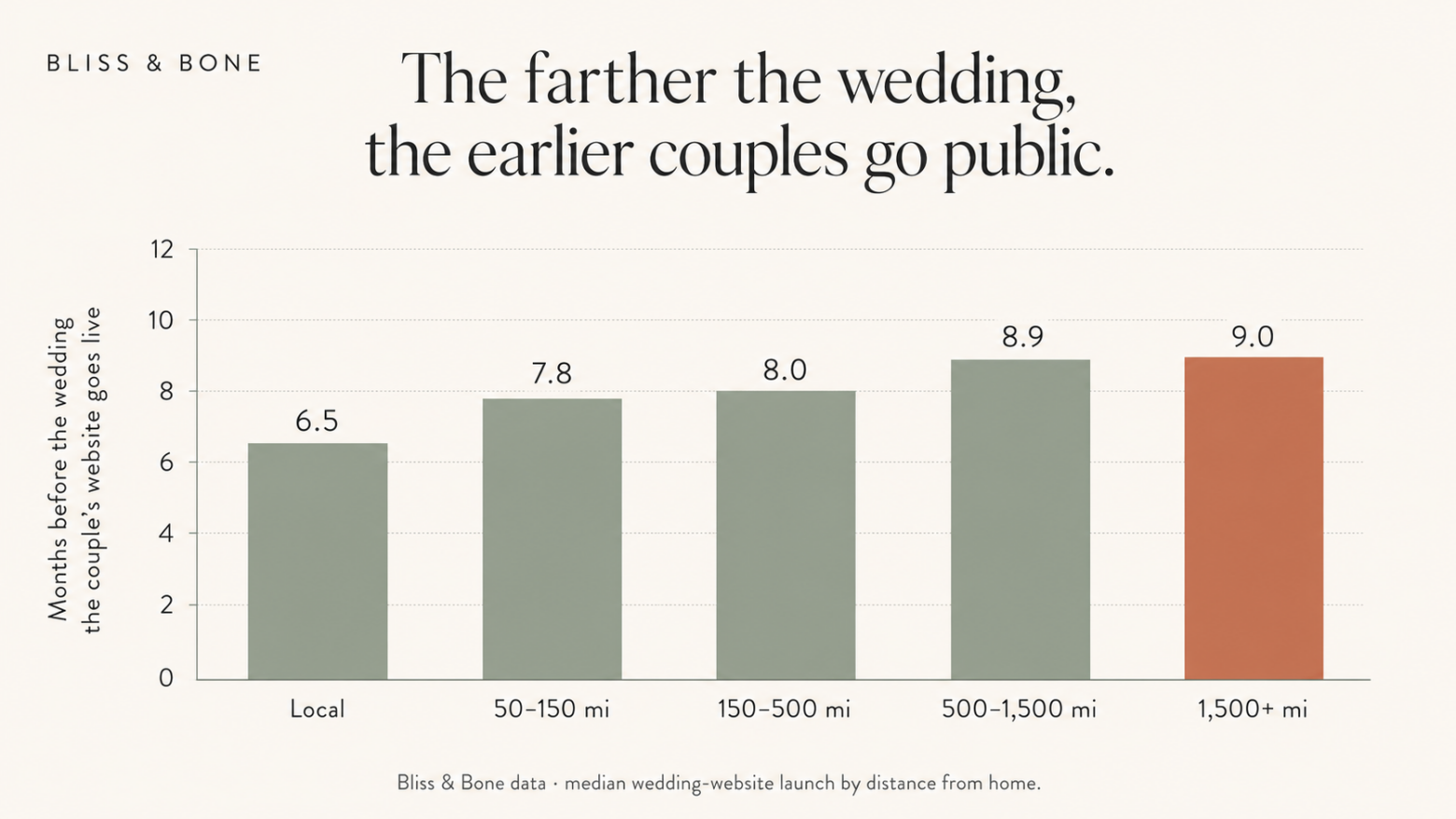
Couples marrying close to home go public with their wedding website around 6.5 months before the day. Couples marrying far away launch closer to 9, and the gap widens at every step of distance. That single pattern, drawn from Bliss & Bone data across thousands of couples, is the whole thesis of this guide: a destination wedding is not a harder version of a normal wedding. It is a different one, because for the first time you are planning your guests' trip, not just your day.
Every other guide on this topic is written by someone with a stake in the destination, a resort, a planner, a travel agent, a photographer who shoots there. Each one optimizes for its own funnel, and each one buries the thing that actually decides whether a destination wedding works: guest logistics. Your guest list self-selects on who can afford the flight and spare the vacation days. That drives your headcount, which drives your budget, which drives everything else. Get the logistics right and the wedding works. Get them wrong and no amount of beautiful backdrop saves it. This guide assumes you have already decided you want a destination wedding, so it skips the pep talk and gets into the execution, starting with how much runway the format actually demands and ending with the paperwork most couples find out about too late. If you are still weighing overall timing, how long it takes to plan a wedding covers the full runway; here we stay focused on the destination-specific work.
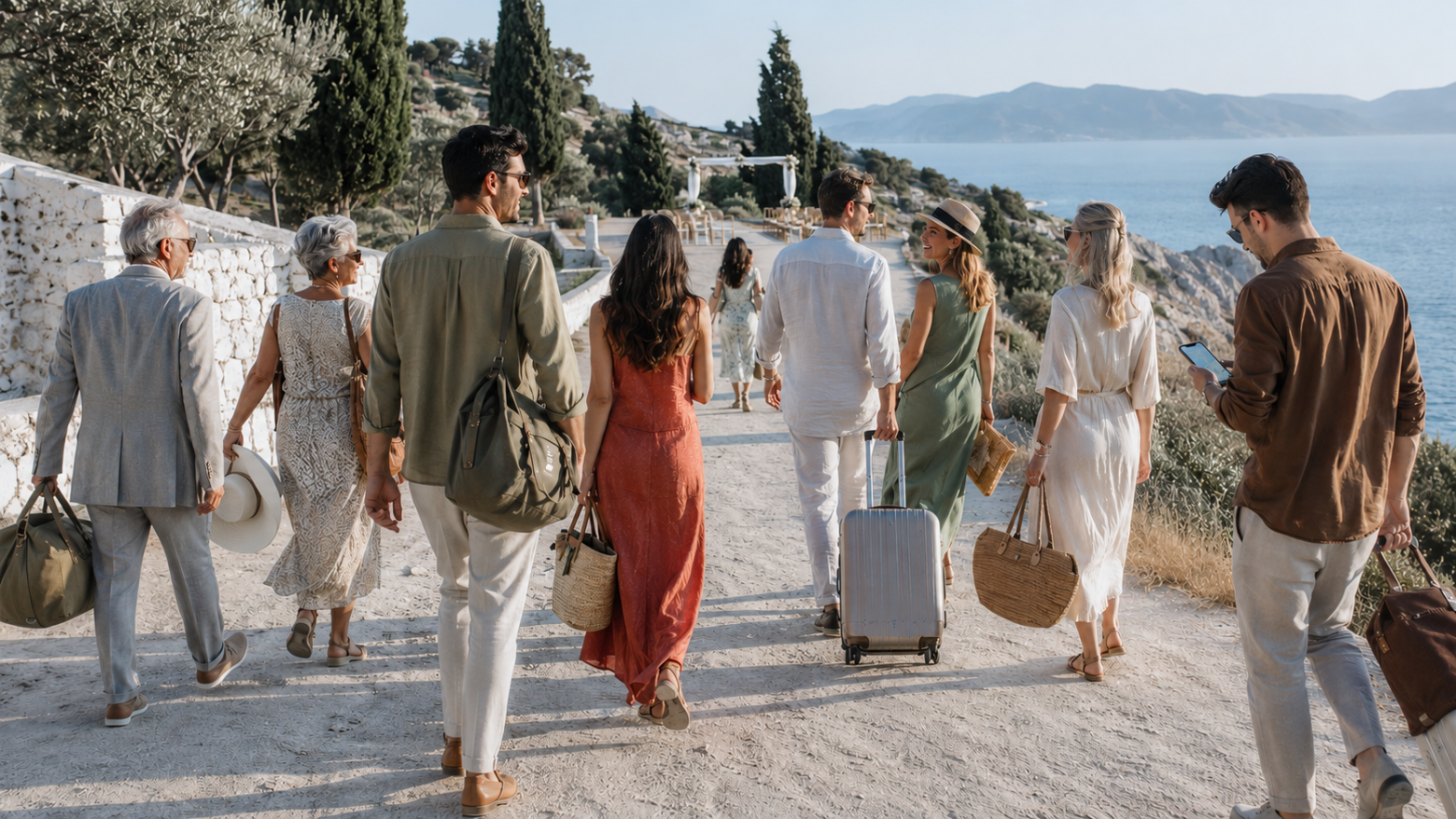
A destination wedding is any wedding where most of your guests have to travel and stay overnight to attend, because the location is somewhere neither you nor the bulk of your guest list lives. That is the working definition, and it is broader than most people assume. A wedding in Tuscany qualifies. So does a wedding in Charleston when you and your guests are spread across the Midwest. The defining feature is not a passport or a beach. It is that attending requires a trip.
That distinction matters because it reframes the whole project. In a hometown wedding, your guests drive over, celebrate, and drive home. In a destination wedding, you are effectively hosting a small multi-day trip for the people you love most, and their cost and calendar become a planning constraint rather than an afterthought.
The upside is real. Destination weddings tend to run smaller and more intimate, the celebration stretches across several days instead of a single afternoon, and the setting does a lot of the decorating for you. The tradeoffs are just as real: a smaller guest list is partly a choice and partly a filter, since some people you love will not be able to make the trip; the planning happens largely at a distance; and if you cross a border, you inherit a layer of legal paperwork that a hometown wedding never touches. None of that is a reason to avoid a destination wedding. It is a reason to plan one differently, which is what the rest of this guide is for.
The single most useful thing to sort out early is whether your wedding is a domestic destination wedding or an international one, because they are not the same project. Most destination weddings are actually domestic. A Hawaii, Napa, or Charleston wedding is a destination wedding in every way that matters to your guests, they are flying, booking hotels, and taking time off, but you keep the things that make planning manageable: one currency, one language, familiar marriage laws, and vendors you can call without doing time-zone math.
Crossing a border changes the work. An international wedding adds passports and validity windows, marriage laws written in another language, currency swings between your deposit and your final payment, and vendor communication that may run through a translator or a local planner. The ceremony you picture on a cliff in Italy is often, legally, two events: a symbolic ceremony abroad and the actual marriage handled elsewhere. We cover that workaround in the legal section, because it is the detail that trips up the most couples.
Competitors conflate these two constantly, which is why so much destination-wedding advice feels vague. Sort your wedding into the right bucket now. If you are staying inside your own country, you can skip most of the legal section and put that energy into guest logistics. If you are crossing a border, the legal section is the most important part of this page.
Pick your destination through the lens of guest feasibility, not just the backdrop. The prettiest location you can imagine is the wrong one if half the people you want there cannot realistically reach it. Before you fall for a place, run three honest tests. How many nonstop or one-connection flights reach it from the hubs where your guests actually live? What does a round-trip flight plus a few nights of lodging cost from those hubs, in the season you are considering? And the one couples skip: can your oldest or least-mobile guests, the grandparent, the friend with a young baby, the relative who does not travel well, actually make this trip? If the answer to that last one is no and those people are non-negotiable, you have your answer.
Timing is the other half of the decision. Every destination has a shoulder season, the window just before or after peak when the weather still holds but crowds thin and prices drop. Marrying in the shoulder season is often the difference between a place your guests can afford and one they cannot, and it usually buys you better vendor availability too. Research the rainy season, hurricane season, and peak-heat months for anywhere you are seriously considering, and weigh them against what your guests will pay to be there.
One underused research move: look at real weddings that have actually happened at the places on your shortlist. Browsing real destination weddings by location on Carats & Cake shows you what a venue looks like as a wedding rather than as a marketing photo, with the vendors who pulled it off attached. It is a faster way to gut-check a destination than any listicle, because you are seeing the finished event instead of the brochure.
A destination wedding has two budgets, not one: yours and your guests'. This is the insight nearly every guide skips. Your guests' budget is not a courtesy consideration; it is a planning input, because your guest list self-selects on who can afford to come. Set the trip cost too high and your headcount shrinks whether you meant it to or not. That is the mechanism that makes guest logistics the first-order constraint of this entire format.
A destination wedding can cost less than a hometown one, mainly because the travel requirement shrinks the guest list and a smaller guest list is the biggest lever on total spend. But whether it actually does, and what any of it runs, depends heavily on the destination, the season, and the size of the celebration. Those numbers deserve their own treatment, so this guide does not quantify them here. For price ranges, averages, and where the money actually goes, see what a destination wedding actually costs. What matters at this stage is the structural point: decide your guest-cost tolerance early, because it silently sets your headcount before you have sent a single save the date.
If you are crossing a border, the legal requirements are the part of destination-wedding planning most likely to blindside you, and the part every competitor covers thinly. Start here, because the answers can change your date and even your destination. Many countries impose a residency requirement, a set number of days you must be in the country before you can legally marry, ranging from a couple of days to several weeks. Many add a waiting period between filing paperwork and the ceremony. Your documents, birth certificates, proof of single status, sometimes a divorce decree, often need an apostille (an international certification) and a certified translation into the local language. And your passport usually needs to be valid for a set window beyond your travel dates, commonly six months. Check every one of these the moment you have a country in mind, because they run on government timelines you cannot rush.
Here is the workaround that solves most of it, and the single most practically useful thing on this page: you do not have to make the wedding abroad the legal one. A large share of couples marrying internationally handle the legal marriage quietly at home, at a courthouse or with an officiant, and then hold a symbolic ceremony at the destination. The symbolic ceremony is the one everyone flies in for. It looks and feels exactly like a wedding, vows, an aisle, an officiant, without any of the foreign residency rules, document translations, or waiting periods, because the legal knot is already tied. It costs you a small, private errand at home and buys you enormous flexibility abroad. Unless being legally married on foreign soil is important to you specifically, this is the path of least resistance, and it is why the destination wedding marriage license question often has a simpler answer than couples fear.
Cross-border weddings also run on a longer clock, which fits the logistics. In our data, couples marrying internationally start their wedding website a median of 9.2 months out, versus 7.3 months for couples marrying inside their own country, a difference of nearly two months. That extra runway is not wasted; it is exactly the time the paperwork above tends to eat.
The specifics vary by country, and the biggest markets each have their own gotcha.
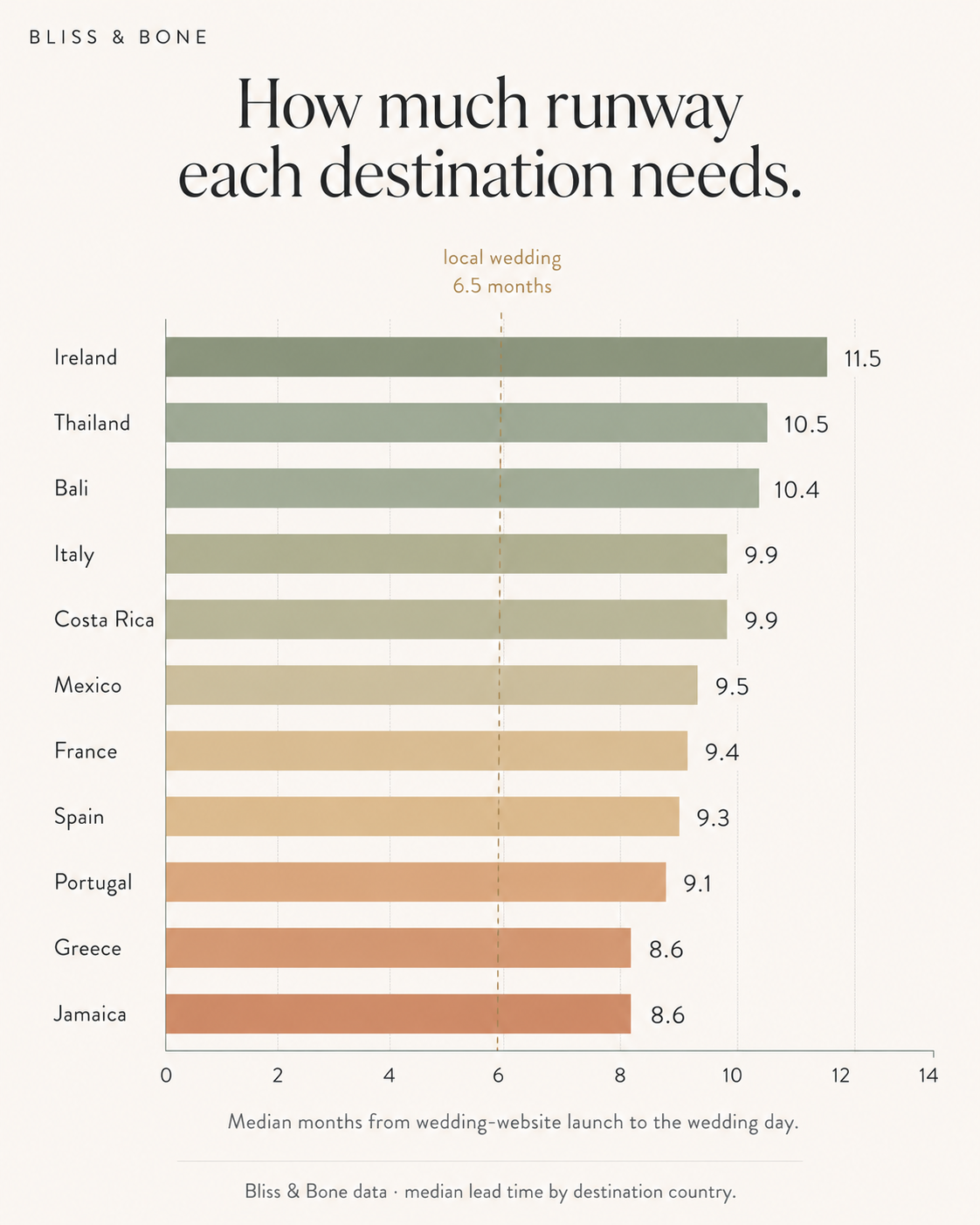
Italy is one of the two largest destination markets in our data, with couples marrying there starting their planning around 9.9 months out. Legal weddings require a Nulla Osta (a sworn declaration that there is no impediment to marriage), often obtained through your home consulate, plus certified translations. The paperwork is very manageable, but it has steps and lead time, which is exactly why many couples marry legally at home and keep the Italian ceremony symbolic.
Mexico is the other giant, with a roughly 9.5-month median runway. Legal marriages require blood tests done locally within a few days of the ceremony and several witnesses, and everything must be filed with the local civil registry. The tight blood-test timing is the classic trap. Many couples sidestep it entirely with a legal ceremony at home and a symbolic one at the resort.
France carries a genuine residency requirement, one partner typically needs to be physically resident for around 40 days before the wedding, which puts a fully legal French wedding out of reach for most travelers. Couples marrying in France, on a roughly 9.4-month runway, almost always do the legal step at home and celebrate symbolically in France.
Greece is one of the more straightforward European options, which is part of its appeal at a leaner 8.6-month median runway. Couples still need documents apostilled and translated, and a short local notice period applies, but there is no lengthy residency hurdle, so a legally binding Greek wedding is realistic for travelers who prepare the paperwork on time.
The central decision when planning at a distance is whether to hire a local planner or fly your own key vendors in. A local planner is worth their fee for almost any international wedding and most complex domestic ones, because they know the venues, speak the language, understand the legal steps, and can be in the room when you cannot. Flying your own photographer or planner in makes sense when a specific creative relationship matters more to you than local knowledge, but it adds travel cost and means your vendor is also working somewhere unfamiliar. Most couples land on a hybrid: a local planner or day-of coordinator for logistics, and one or two hand-picked vendors brought along for the work that is personal.
Site visits are the next question, and the honest answer is that they are worth it when the venue is the entire reason you chose the destination and you cannot fully judge it from photos and video, and skippable when a trusted local planner can be your eyes and the venue has a strong, verifiable track record. If you do only one visit, spend it on the venue and a tasting, not on shopping for vendors you can vet remotely.
Handle contracts, deposits, and payments with the currency question front of mind. Exchange rates move between your deposit and your final payment, so understand whether you are being billed in your currency or theirs, and factor foreign-transaction fees into every number. Set a communication cadence that respects the time-zone gap: agree upfront on how often you will talk, on what channel, and who initiates, so you are not lying awake at 3 a.m. waiting on an email. When you are trying to solve the "how do I even find a good florist in Mexico" problem, working backward from real weddings is faster than a cold search. Vendors tied to real weddings in your location on Carats & Cake lets you start from an event you love and find the people who made it, instead of guessing from a directory.
Here is the mechanism, and it is backed by our data. Destination couples do not plan earlier because they are more organized. They plan earlier because their guests need runway. Couples marrying close to home launch their wedding website around 6.5 months before the day. Move to a wedding 50 to 150 miles away and that stretches to 7.8 months; 150 to 500 miles, 8.0; 500 to 1,500 miles, 8.9; beyond 1,500 miles, 9.0. The line rises at every single distance step, and it rises for one reason: the farther guests have to travel, the sooner they need to book flights and request time off, so the couple goes public sooner to give them that runway. That is the argument for treating guest logistics as a first-order constraint instead of a footnote. (To be precise about what that number is: it measures when couples launch their wedding website, the moment the plan goes public, not when they mail anything.)
Because guests carry more of the load in this format, the timing of your communications shifts too. Guests need to book flights and request time off, so a destination wedding's stationery naturally goes out earlier than a hometown wedding's. The specific windows, how many months and weeks ahead to send what, belong to a page built for exactly that question; see when to send destination wedding invitations for the timeline, and the destination wedding RSVP deadline guidance for when to close replies. The point here is strategic, not tactical: build in more lead time than you would for a local wedding, because your guests are booking travel, not just circling a date.
Your wedding website also does more work in this format than in any other, because it is answering travel questions at scale: how to get there, where to stay, what the schedule is across several days, what to pack, how to handle transfers. It carries operational load a hometown website never has to. Rather than itemize that here, build it well from the start using what to include on your wedding website, and if you want to see how other couples have handled a travel-heavy site, browse destination wedding website examples. A wedding website built for a destination wedding is the single highest-leverage tool you have for keeping a traveling guest list informed without answering the same question fifty times.
Then there is the money question guests actually wonder about and no one answers cleanly. The etiquette here is genuinely different from a hometown wedding, because your guests are already spending real money to attend.
Guests pay their own way. The standard etiquette is that attendees cover their own flights and lodging for a destination wedding, just as they would for any trip. What the couple owes in return is transparency and consideration: give plenty of notice, negotiate a room block so guests get a fair rate, and avoid stacking mandatory extra costs on top of the trip. You are not obligated to fund anyone's travel, but you are obligated to make the trip as affordable and easy to plan as you reasonably can.
The wedding party pays their own travel too, by default, but this is where a thoughtful couple often steps in. Bridesmaids and groomsmen are absorbing the same flights and hotels as guests, plus attire and often a shower or bachelor trip. If your budget allows, covering their lodging, or at least skipping any additional asks, is a real kindness and increasingly common for destination weddings. At minimum, be honest with anyone you ask to stand up with you about the full cost before they say yes.
Traditional etiquette holds that a guest's presence at a destination wedding is a significant gift in itself, and many couples explicitly signal that no further gift is expected. Guests are not obligated to give a physical present on top of thousands spent to attend, and gracious couples make that clear. If you do register, keep it modest and travel-friendly, or lean toward a cash or experience registry that does not ask guests to haul a boxed gift across an ocean.
The through-line across all of this is that a destination wedding asks a lot of the people who come, so the couple's job is to reduce friction wherever possible. Negotiate room blocks and group rates. Arrange transport from the airport and between the hotel and the venue so no one is renting a car in a foreign country. Think in arrival and departure days, not just the wedding day, and build a welcome moment early so travel-weary guests feel taken care of the moment they land. A destination wedding is a multi-day shape, not a single afternoon, and planning it as one is what separates the weddings guests rave about from the ones they quietly resent.
And the strategic payoff of getting all this right: your headcount is decided by who can afford the trip, which means your guest list self-selects on cost. That is not a bug. It is the mechanism that keeps destination weddings small and intimate, and it is why the guest-cost decisions above quietly set the size, and therefore the price, of your entire wedding.
Every other "popular destinations" section is generic filler. This one attaches a real number to each place, drawn from Bliss & Bone data on when couples marrying there start their wedding website. Read the months below as how much runway that destination tends to demand, because a farther, more complex destination pushes couples to start sooner. The pattern is consistent: the more travel and paperwork a place involves, the earlier couples get moving.
One of the two largest destination markets in our data, and for good reason: Tuscan villas, the Amalfi Coast, and Lake Como deliver on the fantasy. Couples pick it for the scenery and the food. The gotcha is the legal paperwork, the Nulla Osta and translations, which is why most keep the Italian ceremony symbolic. Best in late spring or early fall to dodge peak heat and crowds.
The other giant, and the most accessible international option for North American couples thanks to short flights and all-inclusive resorts. Couples pick it for value and ease. The gotcha is the local blood-test timing for a legal marriage, easily solved by marrying legally at home. Best November through April, outside hurricane season.
Santorini and the wider islands offer some of the most photographed backdrops anywhere, on a comparatively short runway. Couples pick it for the light and the sea. The paperwork is manageable with apostilled, translated documents, and a legally binding wedding is realistic. Best May, June, September, or October.
Provence, the Riviera, and châteaux country reward couples who want elegance over beach. The gotcha is the residency requirement that makes a fully legal French wedding impractical for most, so plan on a symbolic ceremony. Best late spring through early fall.
From Mallorca to Seville, Spain pairs strong food and wine with lower costs than much of Western Europe. Couples pick it for warmth and value. Legal requirements are stricter for non-residents, so many marry symbolically. Best May, June, September, or October.
The leading choice for couples who want jungle, ocean, and adventure over old-world formality. Couples pick it for the landscape and the laid-back feel. Legal marriage is relatively straightforward here compared with Europe. Best in the December-to-April dry season.
The Algarve and the Douro Valley have become a value-driven favorite, cheaper than Italy or France with comparable beauty. Couples pick it for the coastline and the wine country. Paperwork is manageable with preparation. Best late spring and early fall.
A Caribbean classic on one of the shorter runways in the data, helped by resort infrastructure built for weddings and a famously simple legal process, only a short residency period before you can marry. Couples pick it for the ease and the all-inclusive model. Best November through mid-April.
The longest runway in our data, and it earns it: castles, cliffs, and a legal process that requires giving formal notice well in advance. Couples pick it for the drama and, often, for heritage. Start early, because the notice period is real. Best May through September.
The two long-haul favorites, chosen for once-in-a-lifetime scenery and strong value once guests absorb the flight. These carry the longest runways after Ireland, because the travel itself demands the most guest notice. Legal marriage is possible but paperwork-heavy in both, so symbolic ceremonies are common. Best in each region's dry season, roughly November to March for much of Thailand and April to October for Bali.
Not every destination wedding needs a passport, and the domestic options solve the hardest problem, guest feasibility, without the legal layer. Hawaii delivers the beach fantasy with US marriage laws and no translations, though it carries the longest domestic flights and a peak-season premium. Napa offers wine-country elegance within easy reach of the West Coast, best outside the fall crush season. Charleston brings Southern charm, walkable historic venues, and strong East Coast access. All three still ask your guests to fly and book hotels, so every guest-logistics rule above applies, but you keep one currency, one language, and marriage paperwork you already understand.
A destination wedding is any wedding where most guests have to travel and stay overnight because it is held somewhere neither the couple nor the bulk of the guest list lives. That includes both far-flung international weddings and domestic ones, like a Charleston or Hawaii wedding, where guests still fly in. The defining feature is that attending requires a trip, not that it involves a passport or a beach.
A domestic destination wedding keeps one currency, one language, familiar marriage laws, and vendors you can reach easily, while asking guests to travel. An international one adds passports, foreign legal requirements, currency swings, and language barriers on top of the same guest travel. Most destination weddings are actually domestic, and sorting yours into the right bucket early tells you how much of the legal and logistical work applies to you.
It can be, mainly because the travel requirement shrinks the guest list, and a smaller guest list is the biggest lever on total cost. Whether it actually costs less depends on the destination, the season, and the size of the celebration, so treat "cheaper" as possible rather than guaranteed.
Guests pay their own flights and lodging, the same as they would for any trip. The couple's responsibility is to give ample notice, negotiate a room block for fair rates, and avoid piling on mandatory extra costs. You are not expected to fund anyone's travel, but you are expected to make the trip as affordable and easy to plan as possible.
By default the wedding party covers their own travel, but many couples help, since bridesmaids and groomsmen are absorbing the same flights and hotels plus attire and pre-wedding events. Covering their lodging, or simply making no additional financial asks, is a common kindness for destination weddings. At a minimum, be transparent about the full cost before asking someone to stand up with you.
Traditional etiquette treats a guest's presence at a destination wedding as a significant gift on its own, so a physical present is not expected on top of travel costs. Many couples make this explicit and keep any registry modest and travel-friendly. Guests who want to give something often choose a cash or experience gift that does not have to be carried home.
No. The travel requirement naturally makes destination guest lists smaller, and it is widely understood that not everyone can or will make the trip. You can invite a wider circle knowing some will decline, or keep it intentionally intimate, but be consistent and thoughtful about where you draw the line so no one feels arbitrarily excluded.
It can be, but many are not, by design. Marrying legally abroad often means navigating residency requirements, waiting periods, and translated documents, so a large share of couples marry legally at home first and hold a symbolic ceremony at the destination. The symbolic ceremony looks and feels like a full wedding without the foreign paperwork, because the legal marriage is already done.
For an international wedding, and most complex domestic ones, a local planner is worth the fee, because they know the venues, speak the language, understand the legal steps, and can be present when you cannot. Simpler domestic weddings or all-inclusive resort packages can sometimes be managed with a day-of coordinator instead. The more unfamiliar the location and the higher the stakes, the stronger the case for local help.
A destination wedding brings guests to a location that requires travel, keeping the celebration social even when it is small. A destination elopement is the couple marrying with no guests or only a tiny handful, prioritizing privacy and the experience over hosting. The dividing line is guests: if you are planning a trip for people to attend, it is a destination wedding, not an elopement.
A destination wedding rewards couples who plan it around their guests instead of around the view. Choose a place the people who matter can actually reach, be honest about what the trip costs them, sort out the legal path early if you are crossing a border, and give everyone the runway the format demands. Do that, and the setting becomes the easy part. Start with the tool that carries the most weight when your guest list is spread across airports: a wedding website that keeps traveling guests informed, and pair it with a wedding planning checklist so nothing slips while you plan from a distance. If you are still choosing your look, destination wedding invitations set the tone from the first thing your guests open.