



Start Designing for Free!
By Bliss & Bone
May 2026
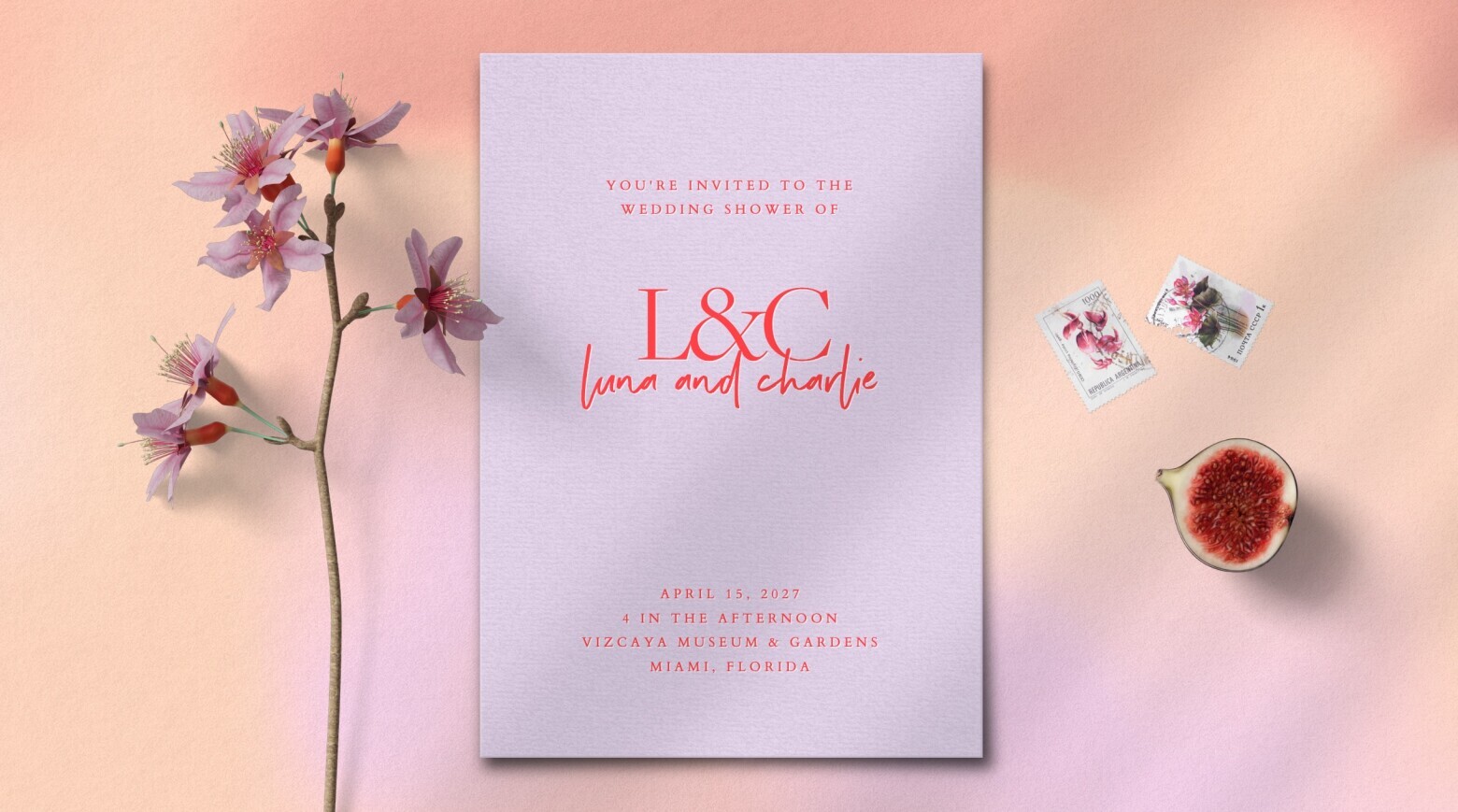
A wedding shower guest list centers on three groups: the wedding party, the couple's immediate family on both sides, and the close friends who would expect to be there. Everyone who receives a shower invitation must also be invited to the wedding. That rule has no exceptions, and breaking it is the fastest way to cause hurt feelings.
Send wedding shower invitations four to six weeks before the date. Guests traveling from out of town need more lead time, so give them an informal heads-up about two months out before the printed invitation follows.
The rest of this guide covers how the guest list shifts for couples and coed showers, how large the list should be, who hosts and sends invitations, and how to handle more than one shower without inviting the same people twice.
The wedding party comes first. Anyone standing up with the couple belongs on the list: bridesmaids, the maid or matron of honor, and the groomsmen at a coed shower. Immediate family follows: mothers, sisters, grandmothers, and aunts on both sides, plus the equivalent relatives of the partner. Close friends who are not in the wedding party but would clearly expect an invitation round out the core list.
Both families get included even when the couple is hosting a single shower. Inviting one side's aunts and cousins while leaving the other side out reads as a slight, regardless of intent. If the guest list starts to balloon, the fix is a second shower rather than an uneven first one.
A shower is smaller and more flexible than the wedding itself. You will not invite every wedding guest to the shower, and you are not expected to. The test is closeness, not obligation. Think of someone the couple would want in a small room celebrating them, not someone on the wedding list for family or professional reasons.
Bliss & Bone's lead stationery designer frames it this way: "The shower list should read like a short version of the wedding list, the same names, just fewer of them. The moment a name appears on the shower list that isn't on the wedding list, something has gone wrong."
Every person invited to a wedding shower must also be invited to the wedding. This is the single firmest rule in shower etiquette, and it exists for a practical reason: a shower invitation implies a gift, and asking someone to celebrate and give while excluding them from the wedding itself looks like a gift grab.
The one common exception is a workplace or community shower thrown by colleagues who already know they are not wedding guests. Even then, the host should make the nature of the event clear, and the couple should never request or expect it. The same courtesy that governs wedding invitation etiquette applies to every shower invitation that goes out.
Before any shower invitations are sent, cross-check the guest list against the wedding list. If a name on the shower list is not on the wedding guest list, it either gets added to the wedding or removed from the shower.
"Wedding shower" and "bridal shower" describe the same event in most cases, and the terms are used interchangeably. The distinction is one of emphasis. "Bridal shower" is the older phrasing and centers on the bride. "Wedding shower" is the broader, more current term, and it covers showers for couples, same-sex partners, and any celebration focused on the wedding rather than the bride alone.
The etiquette does not change with the label. Guest-list rules, timing, and hosting customs apply the same way whether the invitation reads bridal shower or wedding shower. Choose the term that matches the couple: a shower honoring one person who identifies as a bride can use either, while a shower for both partners reads more naturally as a wedding shower or a couples shower.
The traditional bridal shower invited only women. That convention has loosened, and couples showers, where both partners attend and the guest list includes men, are now common. A coed shower opens the list to the full wedding party, close friends of both partners, and family of all genders.
The etiquette rule still holds: everyone at a couples shower must be a wedding guest. What changes is the tone. Couples showers tend to be less formal than a classic tea-style bridal shower, which gives the host more freedom with the venue, the timing, and the guest count.
For same-sex couples, and for anyone who finds the gendered tradition a poor fit, the couples shower is simply the default. Build the list around the people closest to both partners and skip the question of who counts as "the bride's side."
Because a couples shower draws from both partners' circles, the list grows faster than a single-side bridal shower. Hosts usually respond by keeping the event to one combined celebration rather than running separate showers, or by capping the list at the wedding party plus immediate family. The gift expectation tends to be lower-key at a couples shower too, which makes a slightly larger, more casual guest list easier to justify.
Most wedding showers run between 15 and 50 guests. Where a specific shower lands depends on the couple's family size and how many showers are planned. A couple with one shower and large families sits near the top of that range, while a single close-knit group stays near the bottom.
Keep the room in mind. A shower works because it is intimate enough for the guest of honor to actually talk to everyone. Once the list passes roughly 50, the event starts to feel like a second reception, and the gift-opening portion alone can stretch well past an hour.
Send wedding shower invitations four to six weeks before the shower. That window gives guests enough notice to clear their calendars and shop from the registry, without being so early that the date slips their mind.
Out-of-town guests are the exception. Anyone traveling needs roughly two months to book flights and accommodation, so reach them earlier. A text, a call, or an emailed note does the job, with the printed invitation following on the normal four-to-six-week schedule. The logic mirrors save the date etiquette for the wedding itself: travelers get advance notice, everyone else gets the formal piece.
If the shower falls close to the wedding, send shower invitations first so they do not collide with the wedding invitations in guests' mailboxes. Wedding invitations follow their own timeline and should land six to eight weeks before the wedding.
A wedding shower invitation needs six pieces of information: who the shower is for, who is hosting, the date and start time, the location, how to RSVP, and where the couple is registered. Anything beyond that is optional.
List the guest of honor by name, and name the host so guests know who to contact. Spell out the full address rather than just a venue name, since shower venues are often private homes. Give an RSVP method and a deadline roughly one to two weeks before the shower, so the host has a working headcount for food and seating.
Registry information belongs on a shower invitation. This is the opposite of a wedding invitation, where registry details stay off the printed piece. A shower is explicitly a gift-giving event, so naming the registry is expected rather than presumptuous. List the store names or a single registry link, and keep it to one discreet line.
If the shower has a theme, such as a recipe shower, a stock-the-bar shower, or a tea, state it plainly so guests can shop accordingly. Themes only work when guests know about them before they arrive.
Wedding shower invitations are addressed less formally than wedding invitations. Use the guest's first and last name on the outer envelope, and a first name alone works for close friends and family. The rigid title-and-full-name conventions that govern formal wedding stationery do not apply to a shower.
Address each invitation to the specific person invited, not to a household. A shower guest list is individual by design, so "The Smith Family" is the wrong format. If a guest may bring someone, name that person on the invitation rather than writing "and guest."
The couple's wedding invitations follow stricter rules. Those formal conventions are covered in the guide to addressing a wedding invitation, and they do not carry over to showers.
The host sends the invitations, not the couple. A shower was traditionally hosted by someone outside the immediate family, such as a friend, a bridesmaid, or the maid of honor, to avoid any appearance that the family was soliciting gifts. That custom has relaxed, and mothers, sisters, and future in-laws now host showers regularly.
Whoever hosts handles the guest list, the invitations, the venue, and the day-of logistics. The couple's job is to approve the guest list and supply addresses. The host should always get that approval before anything is sent, because the couple is the only one who knows the full wedding list the shower list has to match.
Multiple showers are normal: one from the couple's friends, one from a family member, one from coworkers. The etiquette guideline is that no guest should be invited to more than one shower, with immediate family and the wedding party as the accepted exception, since those people are expected at every celebration.
Splitting the list this way also solves the large-family problem. Rather than one oversized shower, each host takes a natural group, and no one sits through three rounds of gift-opening for the same couple.
No. Everyone invited to a wedding shower must also be invited to the wedding. The only accepted exception is an office or community shower hosted by colleagues who understand they are not wedding guests, and even then the couple should not expect or request it.
Four to six weeks before the shower. Give out-of-town guests an informal heads-up about two months ahead so they can arrange travel before the printed invitation arrives.
The host covers and organizes the shower. That is usually the maid of honor, a bridesmaid, a close friend, or a family member. Costs are sometimes split among the wedding party or among several hosts.
Yes, when there is a single shower. Female relatives, or all relatives for a couples shower, from both families should be included. If that makes the list too large, a second shower is a better fix than an uneven one.
The couple approves it and provides addresses, but the host builds and sends the list. The couple has to sign off because the shower list must match the wedding list, and only they have the complete picture.
In most cases, yes. The terms are used interchangeably. "Bridal shower" centers on the bride, while "wedding shower" is the broader phrasing that also covers couples and same-sex partners. The etiquette is identical either way.
Yes. A shower is a gift-giving event, so registry details belong on the invitation. List the store names or a single registry link on one line. This is the opposite of wedding invitation etiquette, where registry information stays off the printed invitation.
Once the showers wrap up, the wedding itself is next on the calendar. When the couple is ready to send the main event, Bliss & Bone's online wedding invitations and digital save the dates keep the whole guest list, shower and wedding alike, organized and tracked in one place.