



Start Designing for Free!
By Bliss & Bone
September 2026
A cash wedding gift calculator turns four inputs into one number: your relationship to the couple, how many adults you are giving for, where the wedding is being held, and what you are already spending to get there. Convention puts a friend at $100 to $150, a coworker at $50 to $100, and immediate family at $250 and up.
Bliss & Bone · Cash Registry
Seven questions. The amount updates as you answer, and every adjustment is shown.
Regional adjustment uses Regional Price Parities (all items, 2024) from the U.S. Bureau of Economic Analysis. Relationship ranges reflect common U.S. gifting convention.
Give $100 to $150 if you are a friend attending alone, $50 to $100 for a coworker, $150 to $200 for a close friend, and $250 or more for a sibling, parent or child. Adjust down for travel you are paying, and up if you are giving as a couple.
Those bands are conventions rather than measurements. No independent body tracks what American wedding guests actually give, and the figures that circulate each spring come from wedding companies surveying their own customers, a self-selected group with an obvious interest in the answer. Treat any precise national figure with suspicion, including anything this page produces. What a band is good for is settling whether you are in the right neighborhood, which is the real question keeping you up at 11pm the week of the wedding.
The number that matters more than any convention is the one you can pay without resentment. A $75 gift from someone who drove four hours and took a day off work is a larger act than $300 from someone who lives ten minutes away. Nobody at the reception will know either figure, and the couple will not be running a ledger.
Relationship moves the number further than anything else in the calculator, which is why it sits at the top of the form.
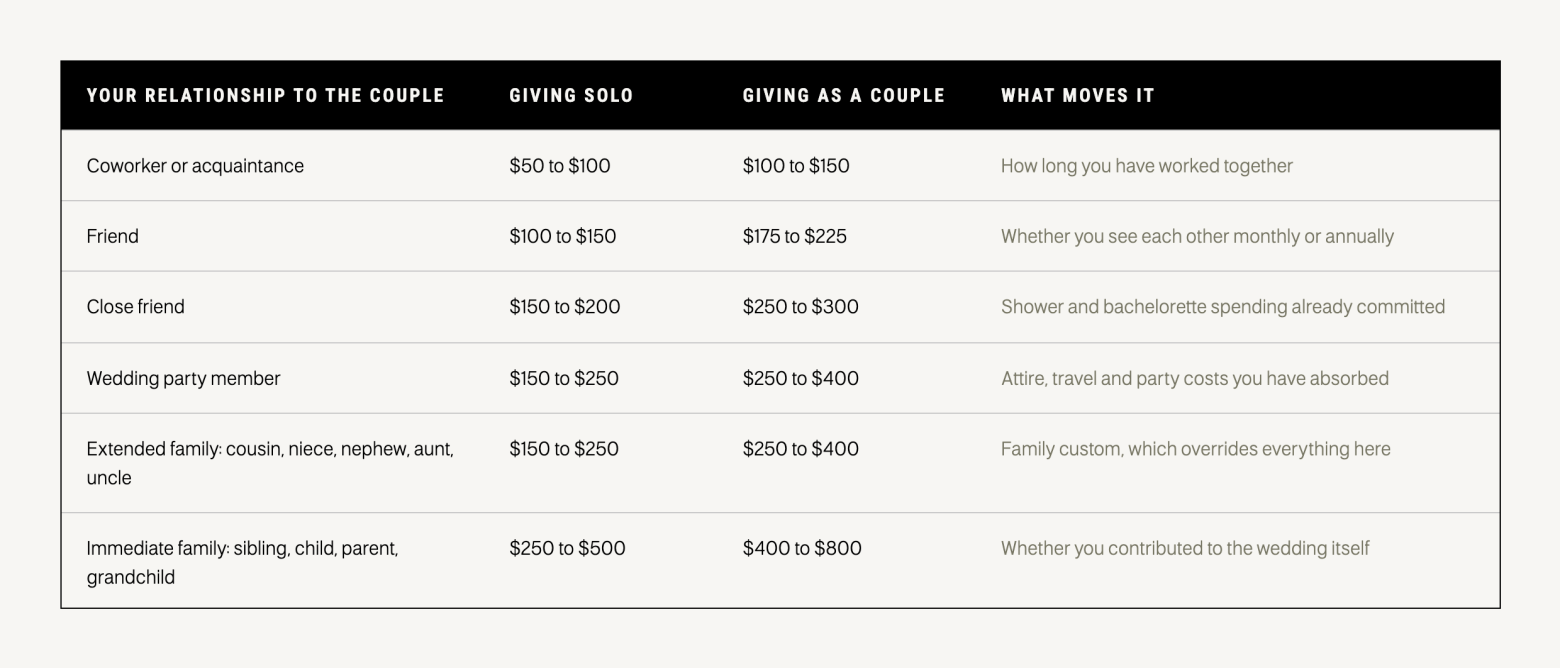
Two of those rows need a caveat. Wedding party members have already paid for attire, hair, a shower gift and a bachelorette weekend by the time the wedding arrives, and that spending counts as part of what they gave. A bridesmaid handing over $150 has given more than a guest handing over $300. The immediate family row sits wide because it covers a parent who paid for the bar and a sibling in their first year out of school, and no calculator resolves that gap for you.
Coworkers are the row guests get wrong in both directions. A colleague you eat lunch with sits at the top of that band, a colleague you have met at two offsites sits at the bottom, and an office group gift replaces the individual one entirely.
Family custom beats national convention every time. If your family gives $200 at every wedding and has for thirty years, give $200. Convention exists for people with no reference point, not to overrule the one you already have.
It is enough, and it sits at the low end. Two adults giving together land in the $175 to $225 range for a friend's wedding under the same convention that puts one adult at $100 to $150. At $100 a couple reads as either a tight year or a distant relationship, and both are ordinary reasons that need no explanation.
A couple does not simply double because the gift comes from a household, not from a seat count. The calculator adds 60 percent for each additional adult instead of 100 percent, which is why two people giving together land near $200 rather than $250. Children in your party add nothing at all. A family of four does not give four times what one person gives, and no couple has ever expected it to.
The calculator adjusts your amount using Regional Price Parities from the U.S. Bureau of Economic Analysis, which measure how much a dollar buys in each state against the national level. In the 2024 figures, California sits at 110.7 and Arkansas at 86.9. Equalized against that spread, $125 in Arkansas and $160 in California carry about the same weight, and a guest who moves between the two states is giving the same gift in different money.
This is the honest version of advice that usually arrives as folklore. Guests hear that New York weddings need more and Midwestern weddings need less, then have no way to size the adjustment, so they either overcorrect or ignore it. A published price index sets the state adjustment at roughly 11 percent above the national line at the top and 13 percent below it at the bottom, which is real money and also a smaller swing than the one a guest braces for when the invitation says Manhattan.
One input the adjustment deliberately excludes: the couple's wedding budget. A lavish reception in a converted warehouse tells you what the couple chose to spend on their own party. It is not a price list, and it says nothing about what they expect from you.
A gift is still customary when you decline, and convention lands near 60 percent of the attending amount. For a friend's wedding, that means $60 to $90 for one person rather than $100 to $150.
The reduction is not a penalty for missing the day. It reflects the fact that the couple is no longer feeding you, and that the seat you released was resold to the headcount. Declining with a gift and no note is the version that stings. The couple set a place for you and then took it away, and a bare payment notification does not close that loop. Send a card within a few weeks of the date and the money can be whatever you can manage.
Guests who were never invited sometimes want to send something anyway, usually a coworker or a distant cousin who heard the news secondhand. Half the attending amount is right, and a card on its own is also right.
Flights, a hotel block, days of leave and a rental car can pass $1,500 per person before the ceremony starts, and all of it was spent on the couple's event. The calculator cuts the gift by 30 percent at the highest travel band, which brings a friend attending alone to roughly $90 instead of $125. That is the intended result rather than a rounding error, and it is the single adjustment guests most often refuse to make for themselves. Travel is the part of the gift that already left your account, so the envelope carries the remainder.
Couples planning destination weddings understand this arithmetic better than their guests do, because they built the guest list knowing exactly what they were asking of everyone on it. The invitation was the acknowledgment. Showing up is the gift, and a modest envelope on top of a long weekend abroad is not something anyone will be counting.
This reverses for a destination wedding you are skipping. You saved the travel, so the decline adjustment applies on its own and the travel offset comes off the table.
A widely used convention splits your total budget for one couple 60 / 20 / 20: sixty percent at the wedding, twenty percent at the shower, twenty percent at the engagement party. Someone planning $200 across everything gives $120 at the wedding and $40 at each of the other two events, which is a far easier conversation with yourself in January than three separate ones across the year.
Tick the shower and engagement party boxes in the calculator and it runs that split in reverse, holding the wedding number steady and deriving the other two from it. Planning all three at once is what stops a guest from giving $150 at a shower in March and then feeling committed to matching it in September.
Bachelorette and bachelor weekends sit outside the split. The trip is the gift, and nobody carries an envelope into a rented house in Scottsdale.
Group gifts work. Pool what each person would have given alone, then send one gift with every name on it.
The trap is the group gift that quietly shrinks. Eight coworkers who would each have given $75 arrive at $600 together, and then someone proposes a $200 espresso machine and everyone agrees because it feels like a lot of money for a kitchen appliance. It is not a lot of money split eight ways. Decide the pool first and the object second.
Office collections need one more rule: nobody's contribution is announced. A junior colleague giving $20 into a pot where a director gave $100 has done the same thing, and the card lists names rather than amounts.
Cash and checks are both correct, and so is a contribution to a cash registry. A check is the safest thing to carry to a reception, since an envelope of bills can walk off a gift table and nobody can trace it afterwards. Write the check to one person by name rather than to "Mr. and Mrs.", because a newly married couple may not have a joint account yet, and a check made out to a name neither of them has legally taken can sit uncashed for weeks while they sort out paperwork.
When the couple has set up a cash registry, use it. The gift arrives logged with your name attached, which solves the couple's hardest thank-you-note problem, and on Bliss & Bone the couple receives the full amount you send. The unmarked envelope on the gift table is why thank-you notes stall out in November.
Timing has loosened without disappearing. Sending before the wedding is ideal, because it keeps a stack of envelopes off the couple's plate on the one day they cannot deal with it. The old grace period of a year after the wedding no longer holds. A few weeks is the working standard.
Whichever method you pick, write a card. A line of handwriting is what separates a gift from a bank transfer, and couples keep the cards.
The cover-your-plate rule tells guests to give whatever the couple spent feeding them, and it is the most repeated advice on this subject. It is also the first thing to drop, because the version of the guest it imagines does not exist.
It fails on its own logic. A guest cannot know the per-head cost, published estimates miss badly in both directions, and the rule charges more to guests of couples who booked an expensive venue while letting the guests of a backyard wedding off cheaply. It also turns an invitation into an invoice, which is the reverse of what the couple did when they sent it.
Couples who ask for money through a wedding registry for cash have already moved past plate math, and their guests can too. Use your relationship and your own budget, then take off whatever the trip is costing you. That is the entire calculation, and it is the one the tool at the top of this page runs.
Every input in the tool is visible in the result, because a number with no arithmetic behind it is worth less than the guess you arrived with. The calculator starts from the relationship band, adds 60 percent per additional adult, applies the decline or travel reduction if either is in play, then multiplies by your state's price level from the Bureau of Economic Analysis. The breakdown panel lists each adjustment as a percentage, so a guest who disagrees with one of them can override it in their head rather than distrust the whole output. Set a ceiling and nothing goes above it, including the shower and engagement party figures.
What the calculator does not do is ask your income, which two of the better-known tools in this category do. Income belongs in your own ceiling, not in a formula, and a tool that raises the recommendation because a guest earns well is charging for a seat rather than describing a convention.
Planning your own wedding and working out how to handle gifts? The wedding invitation etiquette guide covers where registry information belongs and where it does not, and a free cash registry connects to a Bliss & Bone wedding website in a few minutes.
Yes, for one person attending a friend's or a coworker's wedding. It sits at the low end of the friend band and comfortably above the coworker band. From a couple attending together, $100 reads as modest, and it is still perfectly acceptable.
Yes. $500 is a generous gift, appropriate for immediate family, for a wedding party member who can afford it, or for a couple attending together who are close to the pair getting married. Past roughly $500, the amount starts to say something about your finances rather than your relationship.
No, for a coworker, an acquaintance, or a young guest attending alone. It is the floor of the coworker band. Pair it with a written card, and if you are declining the invitation rather than attending, $50 sits comfortably inside convention.
There is no going rate, only convention. The band for a friend attending solo is $100 to $150, adjusted for closeness, party size, location and travel. Any source quoting a precise national average is reporting a survey of its own customers.
Some do and some do not, so check before you send. On Bliss & Bone, the couple receives the full amount you send. Read the checkout screen on any registry that adds a fee, since the number that matters is what reaches the couple.
Follow the couple's signal. A registry with items still on it means physical gifts are welcome. A registry that is mostly a cash fund, or a wedding website pointing at one, means money is the ask. Where both exist, cash is never wrong.
Send it before the wedding, or within a few weeks after. Sending ahead is easier on the couple, who otherwise carry a bag of envelopes home from their own reception. The traditional one-year grace period is no longer the standard.
One third of your wedding gift, which is twenty percent of your total budget for that couple under the 60 / 20 / 20 split. A guest giving $150 at the wedding gives about $50 at the shower.
Run your number at the top of this page, then set up a free cash registry on your own wedding website so nobody attending yours has to guess how to send one.