



Start Designing for Free!
By Bliss & Bone
July 2026
There's no single number, and any page that gives you one is hiding the truth. A large traditional wedding usually takes 12 to 18 months to plan. A small wedding comes together in 3 to 6 months, and a determined couple can pull off a short-notice wedding in 2 to 3. Your number depends on the size of the wedding, the demand for your venue, and how fast you're willing to move.
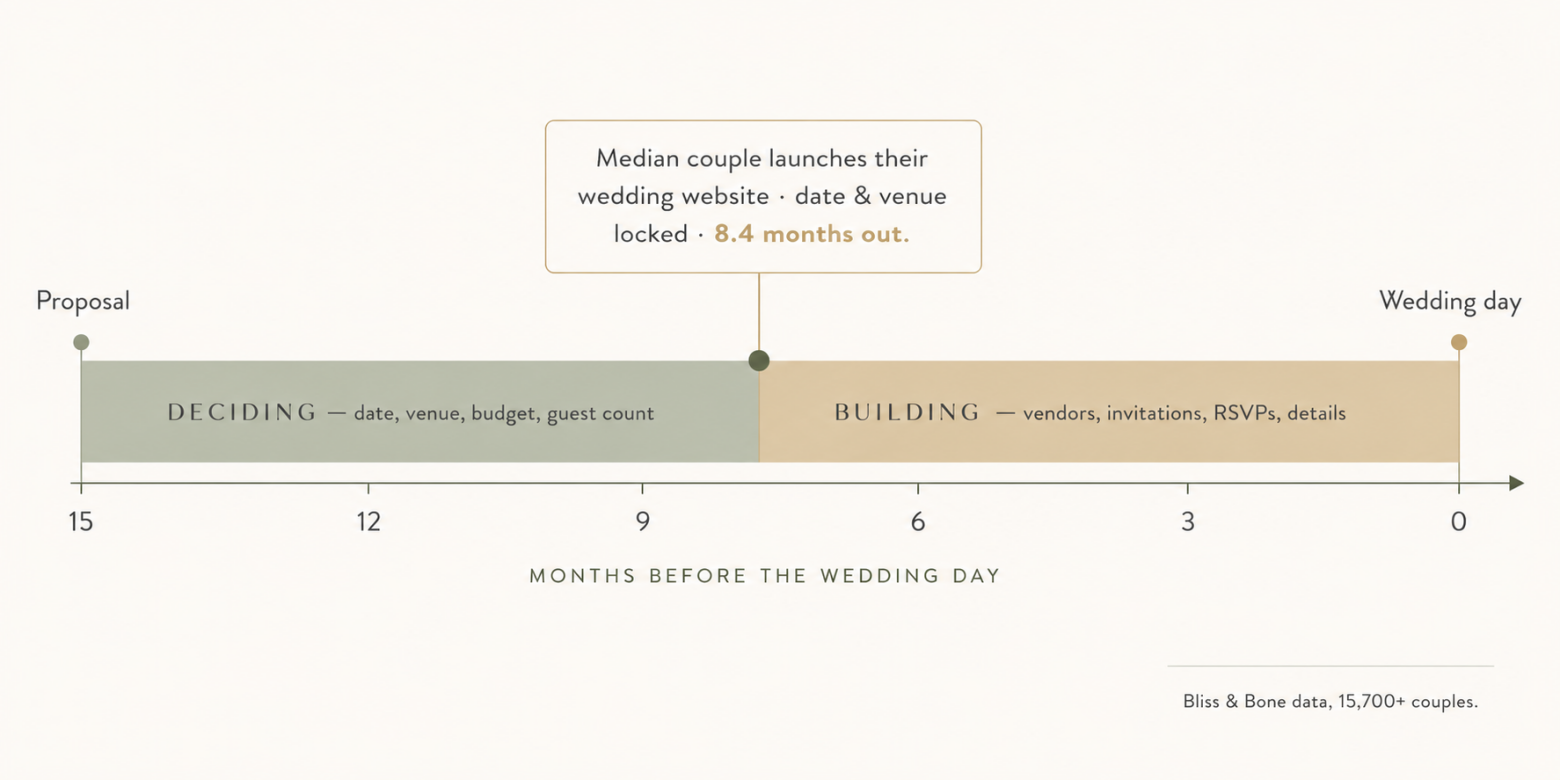
What almost no one can tell you is when planning stops being abstract and gets real. Bliss & Bone data across more than 15,700 couples pins that moment: the median US couple has locked their date and usually booked their venue enough to launch their wedding website 8.4 months before the day. That is not the start of planning. It sits downstream of the two biggest decisions, so the deciding happened earlier. It's the handoff, the point where a couple stops choosing and starts building. The Knot's 2026 Real Weddings Study puts the average US engagement at 15 months. Both numbers are real, and they answer different questions. This page uses ours to show you when the plan goes live, and industry timelines to show you the full runway, broken down by country and wedding type.
Plan on 12 to 18 months for a full traditional wedding, 3 to 6 months for a small one, and 2 to 3 months if you need to move fast. Those ranges come from how long it takes to secure a venue, book vendors, and coordinate guests, and they hold up across the wedding industry.
The often-quoted "15 months" is something else: The Knot's 2026 Real Weddings Study, which surveyed 10,474 couples, measures the average US engagement from proposal to wedding, not the work itself. About 40% of couples land in the 11-to-18-month engagement band. Bliss & Bone data adds the marker those surveys miss. The median US couple has their date and venue locked enough to launch a wedding website 8.4 months before the day, the point where planning turns concrete and public. Read the rest to find the timeline that fits your wedding.

The 15-month number describes your engagement, not your planning. It starts the day you get the ring, and the ring says nothing about whether you have a date, a venue, a budget, or a guest list. Planning also isn't one continuous block. It moves through two phases: a deciding phase, where you settle the date, venue, budget, and guest count, and a building phase, where you book the rest of your vendors, send invitations, manage RSVPs, and handle the hundreds of details that turn a date into an event.
Survey data captures what people remember about the whole span. It can't see the seam between those two phases. The Minted study widely cited on this topic estimates the average wedding takes 528 hours to plan, about 22 full days of work, but it says nothing about when that work happens or when a couple crosses from deciding into building.
Bliss & Bone data marks exactly that crossing. The median US couple has locked their date and usually their venue by the time they launch a wedding website, and that happens a median 8.4 months before the day. Because the website sits downstream of the two biggest decisions, real planning began earlier, during the deciding phase. What the website pins down is the moment the plan goes public. If you just got engaged and you're still weighing dates and venues, you haven't fallen behind. That deciding work is the planning, and it's supposed to come first.
Wedding planning starts the moment you lock a date, and for most couples that moment is downstream of two bigger commitments: choosing a venue and setting a budget. Building the wedding website is the first step that puts all three on the record. It usually requires a confirmed date, often a booked venue, and it's the first time a couple materializes the event in a shareable, permanent form with the story written and guests about to be invited. Earlier activity like Pinterest boards and budget daydreaming is real, but uncommitted. The website is the first thing couples put on the record.
That's why it's a sharper marker than a self-reported engagement date. The engagement clock starts at a ring. The website clock starts at a locked plan. When Bliss & Bone measures 8.4 months of median US lead time, it's measuring the distance from "the big pieces are decided" to "we're married," which a survey about proposal dates can't isolate. "The engagement date tells you when a couple got excited," says the Bliss & Bone insights team. "The website build tells you when the date and venue were locked and the plan went public. The gap between those two events is the most underreported number in wedding planning."
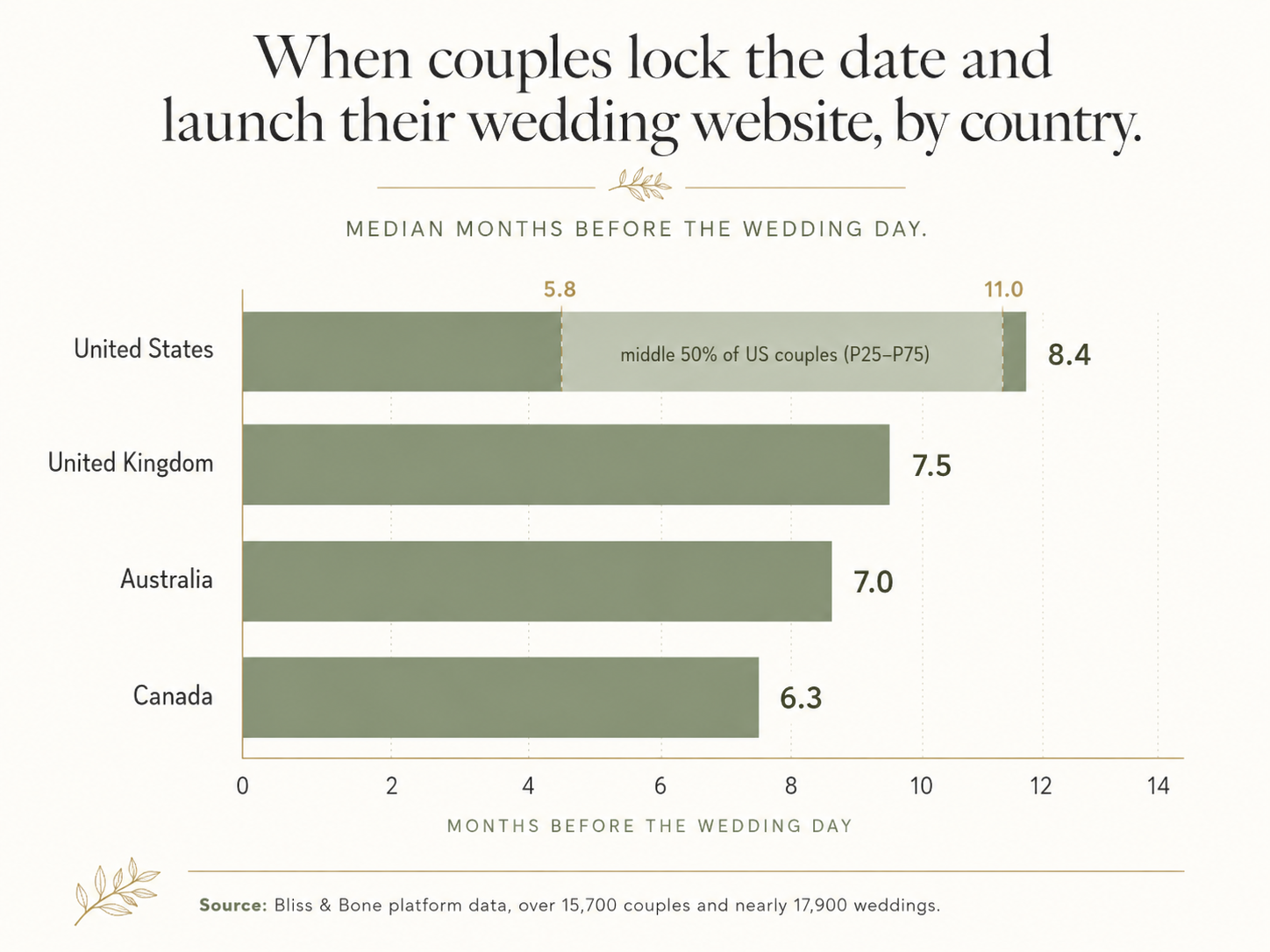
The moment a plan goes public isn't universal either. It shifts by country. Measuring the median lead time from wedding-website launch to the wedding day, US couples go live 8.4 months before the date, UK couples 7.5 months, Australian couples 7.0 months, and Canadian couples 6.3 months. Canadian couples commit closest to the day, roughly two months tighter than Americans, while US couples lock their plans furthest out. Since the website requires a locked date and usually a venue, these gaps track how far ahead couples in each country secure the big pieces, not the full length of planning.
That milestone also hides a real range within a single country. In the US, the middle 50% of couples launch their website between 5.8 and 11.0 months out (the 25th to 75th percentile). That spread is the number competitors can't give you. Some couples lock and go public a year ahead, others just under six months out, and everything between is normal. A single "15 months" figure erases all of it. The percentile range restores it, and it tells you that whether you commit ten months out or five, you are squarely where most couples land.
The type of wedding you're planning moves the timeline more than any other single factor. A large traditional wedding and a backyard elopement are barely the same project, and they run on different clocks.
Large traditional wedding. A full-guest-list wedding with a sought-after venue, a seated dinner, a band or DJ, and a bridal party is the format the 12-to-18-month engagement norm was built for. The constraint is rarely your own pace. It's supplier availability. Popular venues book peak Saturdays 12 to 18 months out, and the best photographers, planners, and florists in a given market follow the same calendar. For a wedding of 100-plus guests in a competitive season, giving yourself 12 months of real planning time (not just a long engagement) is what keeps your first-choice vendors in play. Anything shorter, and you're choosing from what's left.
Small or intimate wedding. A wedding of 50 guests or fewer is genuinely feasible in 3 to 6 months. Fewer guests means simpler logistics, smaller venues with more open dates, and far less coordination. You can often skip the year-out venue scramble entirely because restaurants, private rooms, and small event spaces hold availability much closer in. Intimate weddings collapse the deciding phase and the building phase into one short stretch, because there's less to lock down and less reason to wait.
Destination wedding. Destination weddings take longer, and the Bliss & Bone data shows how common they've become: 63% of couples on the platform plan a destination celebration, and 33% marry outside the country where they live. That reach adds complexity: guest travel and accommodation blocks, legal marriage requirements in a foreign country, site visits, and vendors you can't meet in person. Plan 12 to 16 months of active time for a destination wedding, and lock your date and room blocks first so guests can book flights early. If you're building the guest experience around travel, the destination wedding invitations go out earlier than a hometown wedding's would.
Short-notice or minimum-viable wedding. The floor is roughly 2 to 3 months. It's enough time to secure a small venue or a courthouse-plus-restaurant plan, send digital invitations, and handle the essentials, as long as you accept the tradeoffs: limited venue and vendor choice, a smaller guest list by necessity, and no room for custom lead-time items like heavily personalized printed stationery. A fast wedding is absolutely doable. It just trades optionality for speed.
Start with the three things that gate everything else: your date, your budget, and your guest count. Nothing meaningful can be booked until those three exist, and they're interdependent, so nail them down together rather than in sequence. Your guest count drives your venue size, your venue drives a big share of your budget, and your budget caps your guest count. Circle a rough version of all three within the first month or two of getting engaged, even if you refine them later.
From there, the trigger is your target date, not your engagement date. Count backward from when you want to marry. If you're aiming for a peak-season Saturday at a popular venue, begin the venue search 12 to 14 months out. If you're planning an off-season or intimate wedding, 6 to 9 months of runway is plenty. The mistake isn't starting late. It's starting late relative to your specific venue and season. A March wedding at a low-demand venue and a September wedding at the most-requested barn in the county require completely different lead times.
There's also a seasonal rhythm to when couples make it official. In the Bliss & Bone data, December is the single busiest month for launching a wedding website in every country, accounting for 11.6% to 16.3% of annual launches. That's engagement season showing up in the numbers: the holiday-and-New-Year proposal wave pushes couples to settle a date and go public, so the December-to-February window is when the most plans move from private to public. If you got engaged over the holidays and started calling venues in January, you're moving exactly when everyone else is, which also means you're competing for the same vendor calendars. Once your date and budget are set, walk through what to do after getting engaged to sequence the first moves, and keep a full wedding planning checklist open so nothing slips. For the step-by-step order of what to tackle first, see how to start planning a wedding.
Beyond wedding type, five factors decide whether your timeline runs long or short. Venue availability is the biggest. Peak Saturdays at in-demand venues book 12 months or more ahead, so your date and venue are almost always the binding constraint, and everything else fits around them. Guest count compounds every other decision: more guests means more invitations, a bigger venue, more catering coordination, and a longer RSVP cycle. Budget pacing stretches timelines when couples spread deposits across many months to manage cash flow, which is increasingly common as the average US wedding now runs about $33,000 and pushes past $46,000 in the Northeast.
The other two are about how you work. DIY versus a planner changes the load dramatically: a full-service planner absorbs vendor coordination and can compress a timeline, while a DIY approach needs more calendar room because you're the one making every call. Destination logistics add months for travel coordination, legal paperwork, and site visits. Map these five against your target date and you'll know whether you're on a comfortable 12-month track or a tight one. Setting the budget early is the single highest-leverage move, and a wedding budget template turns the guesswork into real numbers before you commit to a venue.
Yes. Short timelines are common, and our data shows plenty of US couples locking their plans and going public fewer than six months out. Two scenarios cover most fast weddings.
The 6-month plan. This is comfortable for a mid-size wedding if you move on the venue immediately. Book the venue and date in month one, lock your major vendors (catering, photography, music) by month two, send digital save the dates right away, and finalize the guest list and invitations by month three. Six months is enough time for custom stationery if you order early, which keeps the printed pieces on the table rather than defaulting to last-minute digital.
The 3-month plan. This is the fast lane, and it works best for small or intimate weddings. Prioritize ruthlessly: venue and date first, then catering and photography, then invitations. Go digital for save the dates and invitations to buy back weeks of lead time, and keep the guest list tight so RSVP management stays simple. A guest list template keeps headcount under control when you have no margin for churn. The tradeoff at 3 months is choice, not quality: you'll pick from available vendors and dates rather than your dream shortlist, but a beautiful wedding at this speed is entirely achievable.
It depends on the wedding. A large traditional wedding usually takes 12 to 18 months, a small wedding 3 to 6 months, and a short-notice wedding as little as 2 to 3. Bliss & Bone data across more than 15,700 couples shows the median US couple has their date and venue locked enough to launch a wedding website about 8.4 months before the day, the point where planning becomes concrete and public.
You can plan a wedding in as little as 2 to 3 months, especially a small or intimate one. The tradeoff is choice: you'll select from available venues, dates, and vendors rather than a full shortlist, and you'll rely on digital save the dates and invitations to save lead time. Courthouse-plus-restaurant and small private-venue formats are the most realistic at this speed.
Book your venue 12 to 14 months ahead for a peak-season Saturday at an in-demand location, since popular venues fill their best dates a year or more out. For off-season or intimate weddings, 6 to 9 months is usually enough. The venue is almost always the binding constraint on your timeline, so lock it before anything else.
Start settling your date, budget, and guest count within the first month or two of getting engaged, since nothing else can be booked until those three exist. The right moment to begin the venue search depends on your target date and season, not your engagement date. Count backward from when you want to marry, then add lead time for your venue's demand level.
Six months is enough to plan most weddings comfortably if you book the venue and major vendors immediately. It sits inside the normal range: the middle 50% of US couples lock their plans and go public between 5.8 and 11.0 months out. Move fast on the venue, catering, and photography in the first month, and 6 months leaves room even for custom stationery.
A small wedding of 50 guests or fewer takes 3 to 6 months of active planning. Fewer guests means simpler logistics, smaller venues with more open dates, and far less coordination, so you can skip the year-out venue scramble that large weddings require. Small weddings are where planning time and engagement length tend to converge.
The average US engagement is about 15 months, but that's the span from proposal to wedding, not the planning workload. Bliss & Bone data shows the median couple locks their date and venue enough to launch a wedding website 8.4 months before the day, so a good chunk of the engagement passes in the deciding phase before the plan goes public. For the full breakdown of engagement duration by country and age, see our data on average engagement length.
One of the first concrete things couples do once the date is real is claim their wedding website, and our data shows the median couple starts theirs 8.4 months out. It's the step that turns an engagement into a plan: date locked, story written, guests about to be invited. If you're ready to make it tangible, start your wedding website and give your timeline its true starting line.