



Start Designing for Free!
By Bliss & Bone
May 2026

The first thing to do after getting engaged is nothing productive at all. Sit in it. Call the people who will scream. Take the ring photo in good light. The wedding will still be there next week, and the wedding industry will spend the next year telling you to hurry, so the one window you never get back is the part where you are simply engaged and not yet managing a project.
Once you surface, there is a short list of first steps that genuinely matter and a much longer list that does not need you yet. The steps that matter in the first few weeks: get the ring sized and insured, tell your inner circle before the internet finds out, talk through what you both actually want, set a rough budget, and start a wedding website so the day stops being abstract. Everything else, the venue tours and the vendor spreadsheets and the guest-list math, can wait until those foundations are in place.
This is the order we would put them in, based on what tends to go wrong when couples skip ahead.
There is no clock on this. The average engagement in the US runs about 15 months, so even if you did nothing for the first month, you would still be ahead of most couples. There is more on timing in our guide to how long the average engagement lasts.
The pressure to start planning immediately usually comes from other people, not from any real deadline. Resist it for a beat. Couples who pause first tend to make better early decisions, because they are choosing from a place of clarity instead of adrenaline.
When you are ready to move, move in order. The steps below build on each other.
Two practical things protect the most expensive object you now own. First, sizing. If the ring spins, slides, or sticks, take it to a jeweler and have it adjusted before you wear it everywhere. A ring that fits wrong is a ring that gets lost.
Second, insurance. Jewelry insurance typically costs 1% to 2% of the ring's value per year, a small price against loss, theft, or damage. You can add a rider to a renters or homeowners policy, or use a standalone jewelry insurer. Get an appraisal if you do not already have one, and keep the receipt and a few clear photos on file. Do this in the first couple of weeks, while you are still slipping the ring off to show people and most likely to misplace it.
Tell the people who would be hurt to learn it from a feed. Parents and closest family come first, then your innermost circle of friends, ideally by phone or in person rather than a group text. This is also the moment to think about anyone whose feelings need a personal call: a recently widowed grandparent, a sibling having a hard year, the friend who always assumed they would hear first.
Only after the inner circle knows should you announce more widely. The order matters more than the speed. People remember how they found out.
Once your people know, announce however feels like you. A ring selfie, a photo from the proposal, a quiet caption, or nothing at all on social media until later. No etiquette rule requires a public post, and plenty of couples wait weeks or skip it entirely.
If you want a polished announcement photo, book a short engagement session early. Those images double as content for your save the dates, your wedding website, and any printed announcement you send to family. Getting them done early means you have a strong photo on hand the moment you need one.
This is the first step that turns "we're engaged" into "we're getting married," and it is the one most checklists bury at the bottom. Building a wedding website takes an afternoon and gives the wedding a home before you have committed to a venue or a single big deposit.
It is also where the fun starts. Choosing a design, a color palette, and a typeface is the first creative decision you get to make together, and it quietly sets the aesthetic for everything that follows: the save the dates, the invitations, the day itself. Couples who pick a direction early carry it through, and the result feels intentional instead of assembled.
The data backs the early start. Across roughly 15,000 couples on our platform in the US, UK, Canada, and Australia, the design-exploration phase begins 9 to 12 months before the wedding, well before most couples book a single vendor. December is the single biggest month for getting engaged, which means the people browsing designs alongside you in January are your entire cohort. Starting now puts you with them, not behind them.
You do not need final details. A working title, your names, a rough season, and a design you love are enough to create a wedding website that grows as your plans firm up. As Bliss & Bone's design team puts it, the first thing worth building is not a spreadsheet, it is a single page that makes the day feel real. For what to add as you go, see what to include on your wedding website.
Before venues, before vendors, give yourselves a week of pure looking. The goal is to find the aesthetic that feels like you, not the one the algorithm is pushing this season.
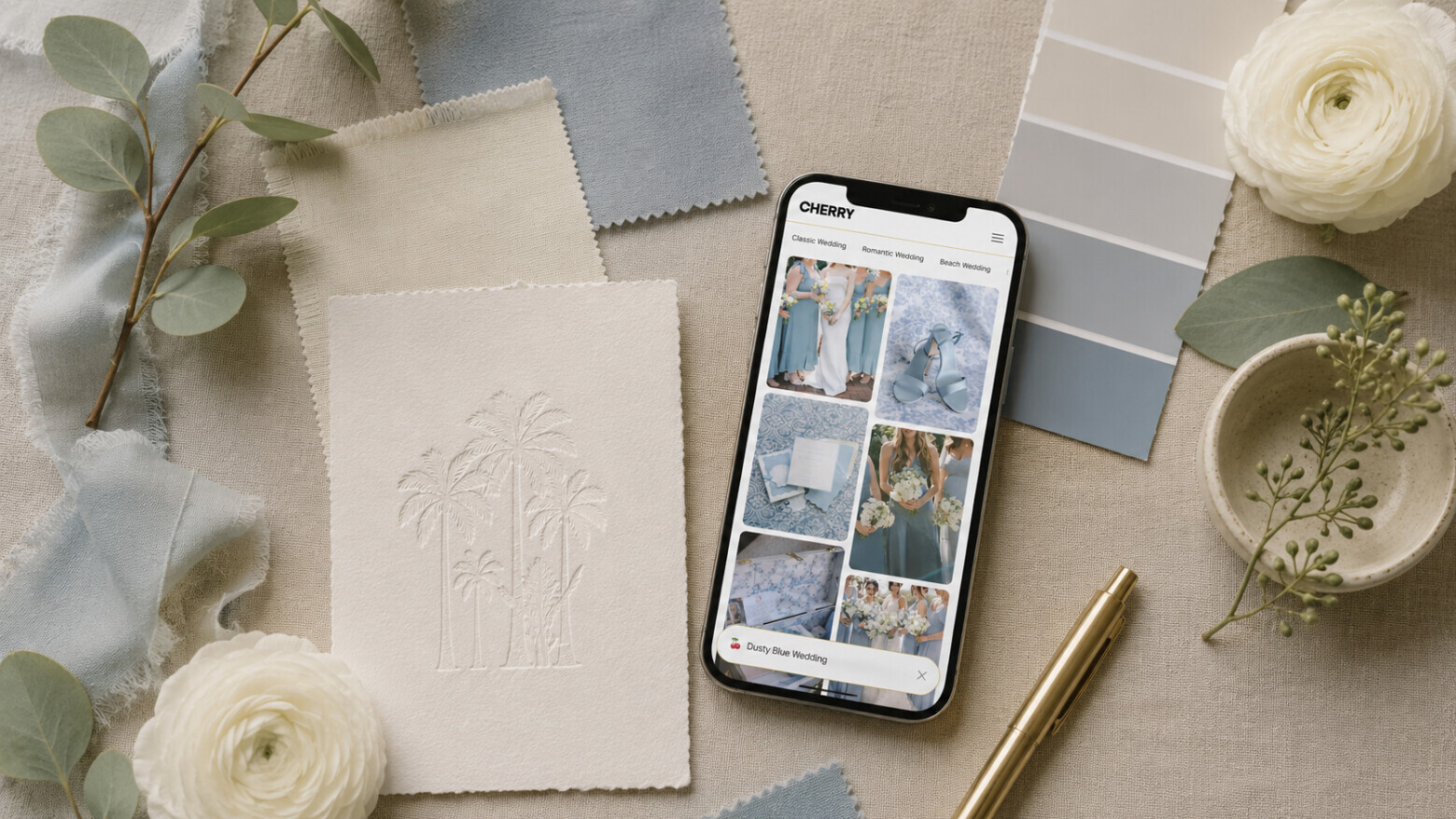
Save images in one place so a pattern can emerge. Cherry by Carats & Cake is built for exactly this. Every image is from a real wedding, never AI-generated and never sponsored, and you can search by color, style, or location, save what speaks to you, build collections, and tap straight through to the vendors who created the moments you love. Browsing a single aesthetic, like a dusty blue wedding, is a fast way to learn whether a direction is really yours or just pretty.
By the end of the week you will have a vocabulary for what you want, which makes every later decision faster and cheaper. Bring that direction back to your wedding website so the colors and mood stay consistent from the very first thing your guests see.
Before anyone tours a venue, have the honest conversation about what you both actually want. Not what your parents want, not what you saw on Instagram, the wedding that sounds like the two of you.
A few questions settle most of the early decisions: roughly how many people, roughly what season, big celebration or small gathering, hometown or destination. You do not need answers locked, but you need to be pointed in the same direction before money is involved. Nearly two-thirds of couples on our platform marry outside their home city or state, so "where" is a bigger early decision than most people expect. Decide the shape of the wedding together first, and the logistics get much simpler.
A budget you set now does not need to be precise, it needs to be honest. A real number, even a rough one, keeps you from falling for a venue or a vendor that was never realistic, which is the most common and most painful early mistake.
Decide three things: the total you are comfortable spending, who (if anyone) is contributing, and the two or three priorities worth spending more on. Put it in writing. A simple wedding budget template does the math and shows you the tradeoffs before you make them. This single document prevents more stress than any other early step.
As long as you want, within reason. The average US engagement is about 15 months, but the active planning window is shorter than that, and no rule says it has to start now.
Most couples spend the first stretch in the soft phase: getting inspired, talking through the vision, building the website, sometimes throwing a party. The heavy logistics, the venue and the vendors and the guest list, tend to kick in later. The average engagement timeline paces out quite differently by country and by age, so what feels slow to your relatives may be right on schedule. And if you want to celebrate before any of the work begins, our engagement party ideas cover when to host and who pays.
A few moves quietly make the next year harder.
Do not announce a wedding date before you have a venue, because the venue almost always sets the date, not the other way around. Do not start booking vendors before you have agreed on a budget and a rough guest count, since both change everything a vendor quotes. Do not let other people's opinions set your priorities in week one, when you are least equipped to push back. And do not invite anyone to the wedding, verbally or otherwise, before the guest list exists, because every "of course you're invited" is a promise you may not be able to keep.
The theme is simple: protect your foundations, meaning budget, vision, and guest count, before you make any decision that depends on them.
Once the foundations are set, the real planning begins, and it has a natural order. Lock the budget and rough guest count, then book the venue and date, then everything else follows. A full wedding planning checklist lays out the whole sequence month by month so nothing falls through.
The first thing to send, well before invitations, is your save the dates. Couples typically send them six to eight months out, or earlier for a destination wedding, so it helps to know when to send save the dates and to have your save the dates onlineready to go from the website you have already built. The online wedding invitations come later, but starting with one connected system, website first, means every piece matches by the time you need it.
Celebrate before you plan. The genuinely useful first tasks are getting the ring sized and insured and telling your closest family and friends in person or by phone. None of the wedding logistics need to start in the first week.
Do not announce a date before booking a venue, book vendors before setting a budget, or tell people they are invited before the guest list exists. Each of these creates promises and constraints that are hard to undo later.
There is no required wait and no rush. The average US engagement is about 15 months, and most couples spend the early months on inspiration and vision before the heavy logistics begin. Start when you feel ready, not when others expect you to.
Yes. Jewelry insurance typically costs 1% to 2% of the ring's value per year and covers loss, theft, and damage. Add a rider to a renters or homeowners policy or use a standalone jewelry insurer, and keep an appraisal and photos on file.
Tell parents and your closest family first, then your innermost circle of friends, ideally by phone or in person. Announce publicly only after the people who matter most have heard it from you directly.
No. A public post is optional and no etiquette rule requires one. Many couples wait weeks, share only a single photo, or skip social media entirely.
After the foundations of vision, rough budget, and a guest-count range, the first real planning step is booking your venue and date, since nearly every other vendor depends on both. Before that, building a wedding website is the easiest early way to make the planning feel real.
As early as you like, even with only your names and a rough season. Couples on our platform begin exploring designs 9 to 12 months before the wedding, and an early website gives your save the dates and invitations a consistent look from the start.
Getting engaged is one moment; the wedding is a year of small, good decisions that follow. Make the first one count by building the home everything else hangs on, then let the rest unfold at your pace.