



Start Designing for Free!
By Bliss & Bone
July 2026
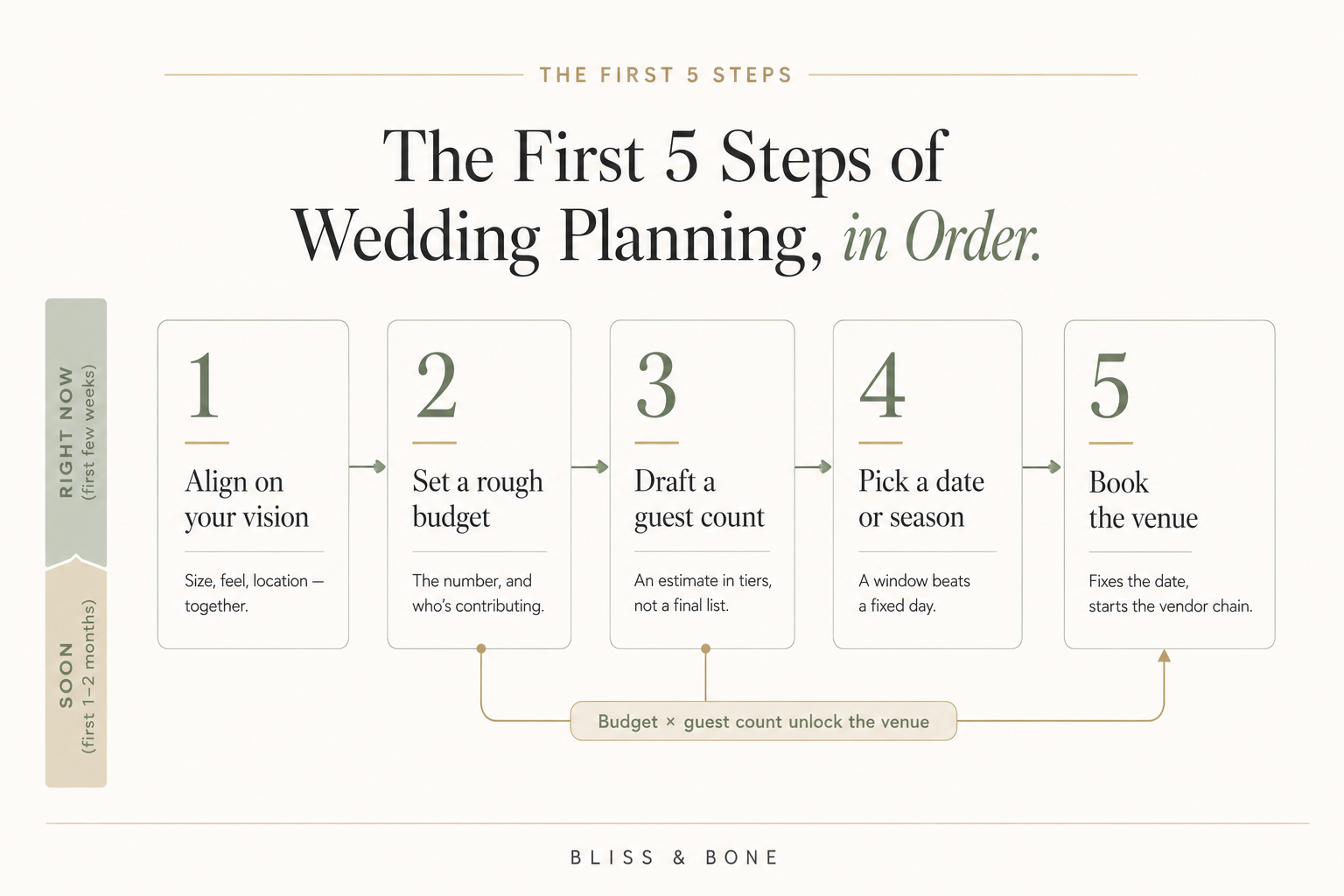
You do not need to do 47 things. You need to do five, in order, and everything else can wait. If you just got engaged and you feel thrilled and slightly buried at the same time, that is the normal reaction to a to-do list that seems to have a thousand items and no obvious first move. The truth is that almost every good wedding rests on the same five foundational decisions, and they have a natural sequence. Make them in order and each one narrows the next, so the choices get easier instead of harder. This is where to start planning a wedding: the first five steps, why each comes when it does, and what to deliberately ignore for now.
That order is not arbitrary. Your vision shapes the budget conversation, your budget and guest count together decide what venues are even possible, and the venue sets the calendar every other vendor books against. Work top to bottom and you are never guessing.
The single best first move is to not plan for a week or two. Every credible source agrees on this, and there is real logic underneath the cliché: the couples who pause and align on what they want first make faster, cleaner decisions later, because they are choosing against a shared picture instead of negotiating one under deadline pressure. Tell the people who matter, enjoy the ring, and let the news settle. If you want a clear sequence for the engagement-specific tasks like sizing and insuring the ring or timing your announcement, that is its own short checklist. See what to do after getting engagedfor that sequence. Then come back here to start the wedding itself.
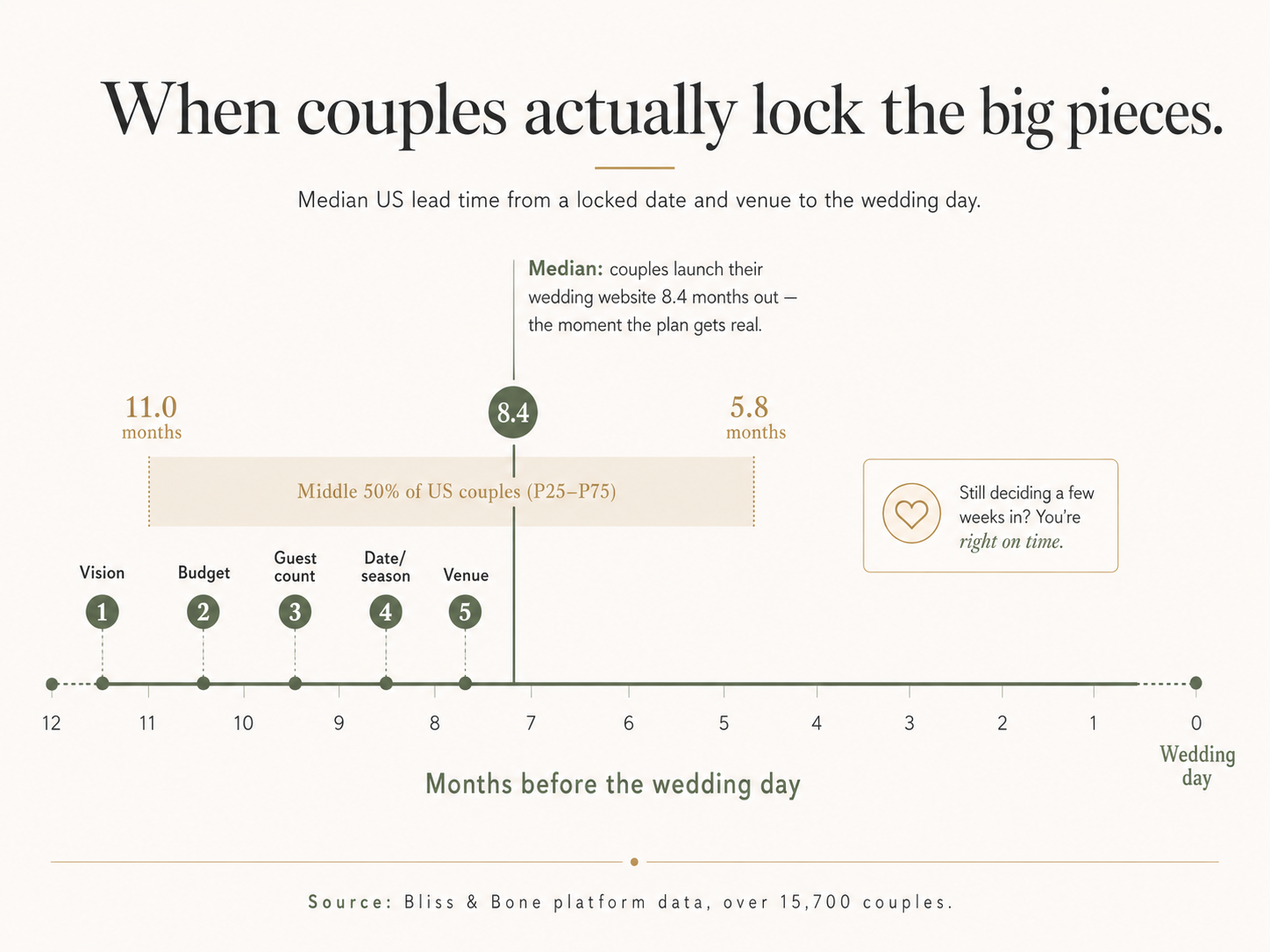
One reassurance before you dive in. Starting soon matters for venues, which book far out, but "soon" is not "today." Bliss & Bone data across more than 15,700 couples shows the median US couple does not lock their date and venue firmly enough to launch a wedding website until about 8.4 months before the day, and the middle 50% land anywhere from 5.8 to 11.0 months out. If you are still weighing options a few weeks after the proposal, you are exactly where most couples are.
Before any spreadsheet, agree on the shape of the day. Big or intimate, formal or relaxed, hometown or destination. This is first because every downstream decision references it: a 200-person black-tie evening and a 40-person backyard dinner do not share a budget, a venue type, or a guest list. You are not choosing colors or a theme yet. You are choosing the category of wedding, and that alone rules out or rules in most of what follows.
Destination is worth deciding early because it changes everything about lead time and logistics. It is also more common than most newly-engaged couples assume: on the Bliss & Bone platform, 63% of couples plan some form of destination celebration and 33% marry outside the country where they live. If that is you, the travel and paperwork move to the front of the line.
The universal starting move here is gathering inspiration, and this is where most guides tell you to "start a Pinterest board." The problem with Pinterest is that the image you fall for often dead-ends: it is staged, AI-generated, or unshoppable, with no path to the real vendor who made it. A better tool for this exact step is Cherry by Carats & Cake, which shows only real photos from real weddings and ties every image back to the vendors who created it. So the bouquet or tablescape you save is not a dead end. You can see who made it, which matters a lot when you reach the vendor step. Not yet: do not lock a color palette or theme to the last detail. Right now you only need the big picture.
Your budget is the second decision because it gates every other one. Guest count, venue, vendors, and the guest experience all price off this single number, so setting it early keeps you from falling for a venue you cannot staff or a guest list you cannot feed. You are not itemizing every line yet. You are answering two questions: what is the total you are comfortable spending, and who is contributing to it, whether that is the two of you alone or family adding to the pool.
Ground the number in reality. The average US wedding now runs about $33,000 and pushes past $46,000 in the Northeast, though plenty of beautiful weddings come in well under that. Decide your number against your own finances, not the average. Once you have a working total, a wedding budget template turns the guesswork into real category allocations before you commit a deposit anywhere. Not yet: do not price out every vendor or build a 40-line spreadsheet. A ballpark and a contribution plan is enough to unlock the next step.
Draft your guest count before you tour a single venue, because headcount decides which venues can even hold you and drives your per-head catering cost, the two biggest levers on the whole budget. A space that is magic for 60 people is a problem for 180, and you cannot evaluate a venue without knowing roughly how many chairs you need. Build the estimate in tiers rather than a final list: the people who are non-negotiable, the people you would love to include, and the people who are nice-to-have. That gives you a realistic range and a built-in way to cut if the numbers get tight. A wedding guest list template keeps the tiers organized from the start, so headcount does not creep.
Here is the dependency to hold onto: guest count multiplied by budget is what actually unlocks the venue. Those two numbers together tell you what you can book. Neither one alone does. Not yet: you do not need addresses, meal choices, or a finalized list. An estimate in tiers is the whole job right now.
Choose a season before you fix an exact date, because a flexible window gives you far more venue and vendor options than a single locked day. If you must have one specific date, expect to compromise on venue. If you can say "early fall" or "late spring," you can chase the space you love and let it set the day. Season also shapes cost and availability: peak Saturdays in demand seasons book first and price highest, and there is a real rhythm to when couples commit. In Bliss & Bone data, December is the single busiest month for launching a wedding website in every country, the holiday-proposal wave settling dates all at once, which means the winter-into-spring window is also the most competitive for popular venues.
How far ahead you need to start depends entirely on the wedding you defined in Step 1, and that timing question has its own detailed answer. For the full breakdown of runway by wedding type and how far in advance to book, see how long it takes to plan a wedding. Not yet: you do not need the exact day locked to start touring venues. A season and a rough month is enough to begin.
The venue is the first decision with a real deadline, which is why it sits at the end of the foundation and the start of everything else. Popular venues book their best dates 12 months or more ahead, so once your vision, budget, guest count, and season are set, this is the thing to move on. Booking the venue does two jobs at once: it fixes your date for real, and it starts the vendor chain, because every other vendor books against that confirmed date.
Then comes the question that makes people freeze: how do I even find vendors when I do not know where to start? The calm answer is to work backward from images you already love rather than cold-searching a directory. If you saved real weddings on Cherry during Step 1, each photo connects to the actual vendor who created it, so the inspiration you gathered becomes your shortlist. That closes the loop from "I like this" to "I can book this." After the venue, book in order of how early each vendor's calendar fills: photographer and planner tend to go first, then caterer, florist, and music, then the rest. You do not need to memorize that full sequence now. That is exactly what the checklist is for. Not yet: do not try to book every vendor this month. Venue first, then the two or three that book earliest.
Once the date and venue are locked, one of the first things couples do is make the plan tangible, and the data backs this up: launching a wedding website is the step where an engagement becomes a real event with a date, a story, and guests about to be invited. Bliss & Bone data puts that moment at a median of 8.4 months before the day for US couples, the point where planning stops being abstract. A wedding website gives your plan one home base, keeps everyone informed as details firm up, and quietly organizes the next phase of work. It is also a natural place to collect the vision you built in Step 1.
You have done the hard part. The five foundational decisions are the ones that feel impossible from a standing start, and once they are made, the rest of planning is execution: steady, month-by-month, and far less frightening than the blank page you began with. From here it is booking the remaining vendors, sorting stationery, and coordinating the guest experience, all of it sequenced for you. When you are ready to hand off from "where do I start" to "what's next," work through the full wedding planning checklist. It picks up exactly where these five steps leave off.
Align with your partner on the vision for the day before anything else: the rough size, the overall feel, and whether it is local or a destination. Every later decision, from budget to venue, references that shared picture, so making it first keeps the rest of planning consistent. Take a week or two to enjoy the engagement before you begin.
Start by shrinking the list. You only need five decisions to begin: vision, budget, guest count, date or season, and venue, made in that order. Ignore everything else until those are set. The overwhelm comes from treating a hundred tasks as equally urgent, when in reality four of them unlock all the others.
Book your venue first. It is the decision with the earliest real deadline, since popular venues fill their best dates 12 months or more ahead, and it fixes the date that every other vendor books against. Before you can choose a venue, though, you need a rough budget and guest count, because those two numbers decide which venues are possible.
Vision, budget, guest count, date or season, then venue. The logic is a dependency chain: your vision shapes the budget, your budget and guest count together determine which venues you can afford and fit, and the venue sets the calendar for every vendor after it. Following the order means each decision narrows the next instead of contradicting it.
Work backward from images you already love rather than cold-searching a directory. Tools like Cherry by Carats & Cake tie every real wedding photo to the vendors who created it, so the inspiration you save becomes a shortlist of bookable, real vendors. After your venue, reach out to the vendors whose calendars fill earliest, typically photographer and planner first.
No. You can make all five foundational decisions yourself, and many couples never hire a full planner. A planner helps most once you are deep in vendor coordination and logistics, not at the starting line. If your wedding is large, a destination, or on a tight timeline, bringing a planner in early can absorb the coordination load, but it is optional to begin.
Start soon, but you are not behind if it has been a few weeks. Venues drive the timeline because they book furthest out, so begin the venue search 12 to 14 months ahead for a peak-season Saturday, and 6 to 9 months is comfortable for an off-season or intimate wedding. For a full breakdown by wedding type, see our data on how long it takes to plan a wedding.
Wedding planning only feels impossible when every task looks equally urgent. It is not. Five decisions carry the weight, they have an order, and once you make them the rest falls into a sequence you can actually follow. Align, budget, count, date, venue. Do those, make the plan real, then let the full wedding planning checklist carry you the rest of the way.