



Start Designing for Free!
By Bliss & Bone
May 2026
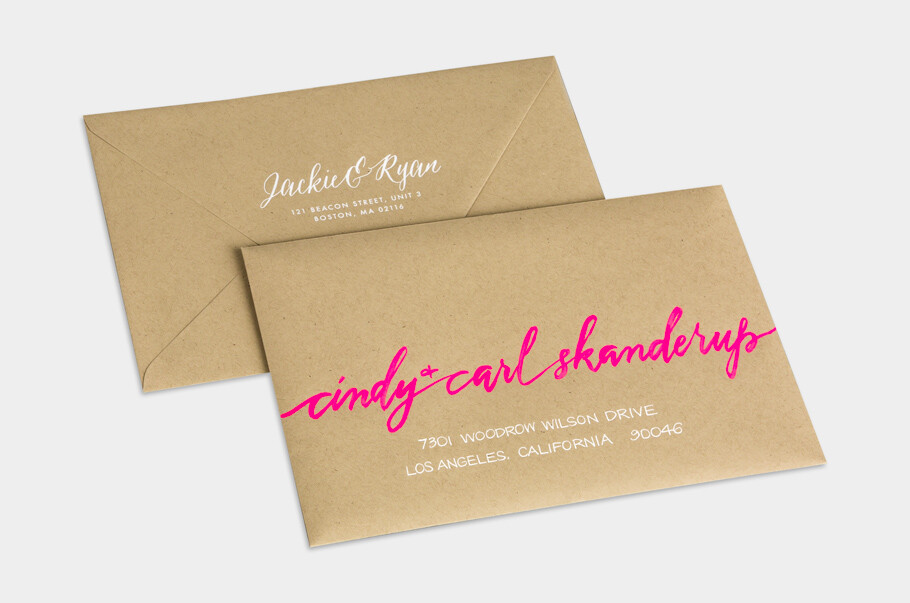
The envelope is the first thing a guest holds. Before they see the invitation, the font, or the paper, they see the envelope, and the choice of size, color, addressing style, and seal sets the tone for the entire wedding. Most couples treat envelopes as an afterthought, then run into trouble at the post office or end up with a suite that looks mismatched the moment a guest pulls it from the mailbox.
This guide covers every envelope decision you need to make before mailing. Sizes and what fits inside them, the difference between inner and outer envelopes, addressing conventions, liners and seals, postage rules, and the small details that separate a suite that looks intentional from one that looks rushed. For the deep mechanics of how to write names and titles on the outer envelope, the how to address a wedding invitation guide covers every scenario. This article focuses on the envelope itself.
A wedding invitation envelope has more moving parts than guests realize. Understanding the components is the foundation for every other decision: what size to order, whether to use one envelope or two, and how to address it once it arrives.
The outer envelope is the one the postal service handles. It carries the guest's mailing address on the front, the return address on the back flap or upper left corner, and the postage stamp in the upper right. It is the workhorse of the suite, built to survive sorting machinery and rough handling, and large enough to hold every piece of the invitation suite stacked together.
The inner envelope is the optional second envelope that sits inside the outer one. It is unsealed, unstamped, and carries only the guest's name, typically in a less formal style than the outer. Its job is decorative and clarifying: it protects the inner suite from any damage to the outer envelope, and it lets you specify exactly who is invited (more on this in the next section). Inner envelopes are a traditional touch that has become less common in modern weddings, but they remain standard for formal events.
The flap is the part that folds down to seal the envelope. Three common styles appear in wedding stationery: pointed (also called Baronial), Euro (deep V-shape), and square (straight edge). Pointed and Euro flaps read as more formal and dressy; square flaps feel modern and clean. The flap style is the most visible design choice after the envelope color and is worth considering as part of the overall aesthetic.
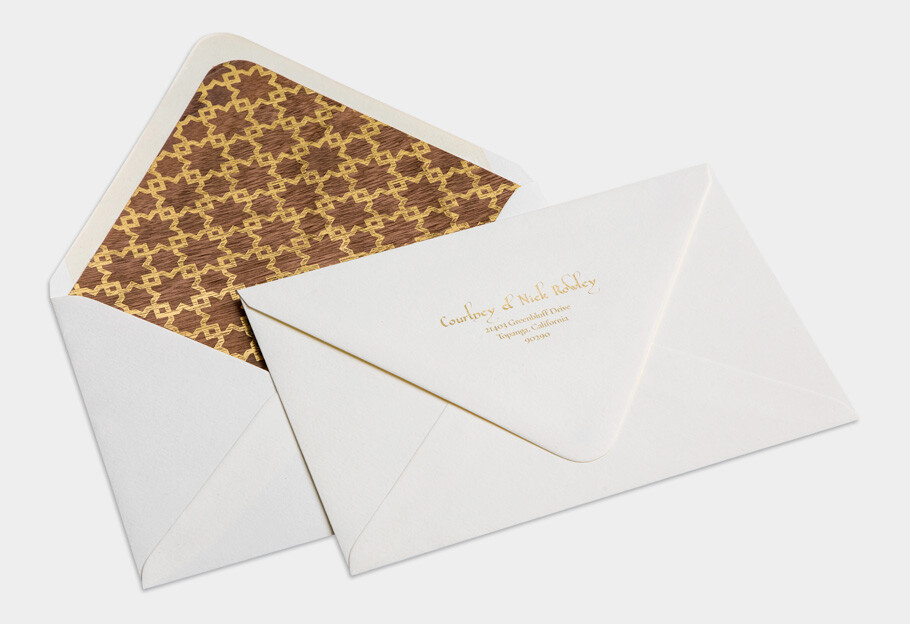
The liner is an optional decorative paper insert glued or tucked into the inside of the outer envelope flap. Liners are a way to add color, pattern, or a small design moment to an otherwise plain envelope. They serve no functional purpose but signal care and elevate the unboxing moment.
The seal is what closes the envelope. Most modern envelopes use gummed or peel-and-seal adhesives. Wax seals, monogram stickers, and decorative labels are common upgrades for formal or maximalist suites.
This is the first question most couples ask, and the answer is almost always no. Inner envelopes were the standard a generation ago, when invitations were delivered by hand or by courier and the outer envelope was discarded before the inner one was presented on a tray. That convention has largely faded.
Today, you only need inner envelopes if any of the following apply to your wedding. The event is genuinely formal, such as black tie, a hotel ballroom, or a traditional cathedral ceremony. You are sending a multi-piece suite with several enclosure cards, and you want a clean way to keep everything together. You have a complicated guest list with families or households where you need to be unambiguous about exactly who is invited.
That last reason is the most practical. If you are inviting one couple from a household but not their adult children, the inner envelope is a clean way to communicate that. The outer envelope reads "Mr. and Mrs. Charles Whitman." The inner envelope reads "Charles and Margaret." The children's names are not on the inner envelope, which signals clearly and without awkwardness that the invitation is for the parents only.
If you skip the inner envelope, the same information has to be conveyed through wording elsewhere (your wedding website, conversations with parents) or through the absence of names on the outer envelope itself. For most couples, that works. For formal weddings with sensitive guest list dynamics, the inner envelope is worth the additional cost.
The cost difference is meaningful. Double envelopes typically run 30 to 50% more than single envelopes once you account for the larger outer envelope needed to accommodate the inner one. For a guest list of 150, that can be the difference between $0.50 and $1.50 per suite. Meaningful at scale, but not prohibitive for couples who want the formality.
If you go with a single envelope, your guest's name and address both appear on the outer envelope, the same as any standard piece of mail. The single-envelope approach is correct, modern, and entirely appropriate at every level of formality short of black tie.
Envelope sizes are standardized across the stationery industry, but the naming conventions can be confusing. The size you need depends entirely on the invitation card it has to hold.
The rule of thumb: your envelope should be ¼ inch larger than your invitation card on both height and width. That clearance is what lets the card slide in cleanly without creasing the corners or jamming at the flap.
The most common sizes you will encounter:
A7 (5.25" × 7.25") is the standard for the modern wedding invitation. It holds a 5" × 7" card, the most common invitation size in the U.S., with the right amount of clearance. A7 envelopes mail at the standard First-Class letter rate, fit through standard sorting machinery, and are available in dozens of colors and finishes across every major paper supplier. If you have no idea what size to order, the answer is A7.
A6 (4.75" × 6.5") fits a 4.5" × 6.25" card, slightly smaller than the standard. A6 reads as a touch more delicate or restrained and is common for intimate or minimalist suites. Postage and machinability are the same as A7.
A2 (4.375" × 5.75") is the standard RSVP card envelope. It holds a 4.25" × 5.5" reply card and is what guests use to mail their RSVPs back to the host address. A2 envelopes typically appear pre-printed with the host's return address.
4 Bar / A1 (3.625" × 5.125") holds small enclosure cards like reception details, accommodation cards, or thank you notes. Less common in modern suites where information has migrated to the wedding website.
A9 (5.75" × 8.75") is one step up from A7, used for oversized invitation cards or suites with multiple enclosures. A9 still qualifies for the standard letter rate as long as the suite stays under ¼" thick and 1 oz, but it is taller than standard and may attract surcharges if it pushes the limits.
Square envelopes (5" × 5", 6" × 6", 7" × 7") are popular for modern and geometric suites. The aesthetic is striking, but square envelopes cannot be processed by USPS letter-sorting machinery and incur a non-machinable surcharge, currently $0.49 per piece on top of the standard letter rate. For a 150-guest list, that is an additional $73 in postage. Worth knowing before you commit to the look.
One naming gotcha worth flagging: when American designers say "5×7 invitation," they mean the card itself measures 5" × 7". The correct matching envelope is called an A7 and measures 5.25" × 7.25". Searching for a "5×7 envelope" online will sometimes return envelopes that are exactly 5" by 7", which is too small for a 5" × 7" card. Always search by the A-size name (A7, A6, A2) to get the right product. For the full breakdown of card dimensions and how they pair with envelopes, see wedding invitation size.
Addressing is where most couples spend the most time, and where the highest number of small etiquette decisions get made. This section covers the format and structure of envelope addressing. For the full breakdown of every household type, including married couples, same-sex couples, families with children, single guests, professional titles, and divorced and widowed guests, the dedicated how to address a wedding invitation guide covers all of it in detail.
The outer envelope carries the guest's full name, formal title, and complete mailing address. The address sits in the center of the envelope, with each line stacked cleanly: name, street address, city and state, zip code. The return address goes either on the back flap (traditional) or in the upper left corner of the front (modern). Both are correct. The back flap reads as more formal and is preferred when the rest of the suite is traditional.
A few formatting conventions worth holding to:
Spell everything out. "Street," not "St." "Apartment," not "Apt." "California," not "CA" on formal invitations. Two-letter state abbreviations are acceptable for casual or modern weddings but should be applied consistently across every envelope. Don't mix "California" and "TX" on the same guest list.
Use formal titles on the outer envelope. Mr., Mrs., Ms., Dr., The Reverend, The Honorable. Save first-name-only addressing for the inner envelope (if you have one) or for very casual weddings where the entire suite has been styled to match.
Middle names are optional. If you use them for one guest, use them for everyone, or use them for none. Inconsistency reads as an oversight, not a stylistic choice.
Never abbreviate "Doctor" as "Dr." on a formal outer envelope. Spell it out: "Doctor Sarah Patel and Mr. James Patel."
If the inner envelope is used, addressing convention shifts. The inner envelope drops the address entirely (since the postal service has already delivered the envelope and doesn't need it) and uses a less formal version of the guests' names. Outer: "Mr. and Mrs. James Anderson." Inner: "James and Sarah." For families, the inner envelope is where children's names appear. The outer addresses parents only, the inner lists every invited household member.
The decision between handwriting, calligraphy, and digital printing depends on the formality and the budget. Hand calligraphy is the traditional choice and runs $3 to $10 per envelope from a professional calligrapher. Digital calligraphy printing, where the calligraphy design is created digitally and printed directly onto the envelope, runs $1 to $3 per envelope and is indistinguishable from hand work to most guests. Printed labels are the practical option for large guest lists or casual weddings. They should match the typography of the invitation suite and be applied straight and centered. Handwriting is the lowest-cost option but only works if your handwriting (or that of someone you trust) is consistently legible.
Liners are the decorative paper insert that sits inside the flap of the outer envelope. They are visible the moment a guest opens the envelope and serve as a small design moment between the outside of the suite and the invitation itself.
The four most common liner styles:
Solid color. A flat sheet of paper in a complementary color to the envelope or invitation. Most restrained and works with every aesthetic.
Patterned. Repeating motifs like florals, geometrics, or stripes. Reads as more decorative and pairs well with maximalist or themed weddings.
Metallic. Gold, silver, or copper foil-printed paper. Adds shimmer and works for formal weddings.
Custom printed. A monogram, map, illustration, or photograph printed onto the liner paper. The most personal option and the most expensive.
Liners are not necessary. They add roughly 10–20% to the per-envelope cost and require additional production time. Skip them when the envelope itself is colored or textured (a liner inside a sage green envelope is redundant), when the invitation suite leans minimalist, or when budget is a constraint.
Use them when the outer envelope is plain (white, ivory, cream) and you want to add visual interest, when the suite is maximalist and the liner becomes part of the design language, or when you have a meaningful motif (a monogram, your wedding location's map, your save the date illustration) that earns the additional cost.
Liners can be pre-installed by the printer when you order envelopes, or assembled at home using pre-cut liner sheets and a glue stick. DIY liners save money for couples with time but require patience. 150 envelopes is roughly 5 to 6 hours of focused work.
The paper your envelope is made of carries as much weight as the design printed on it. A thin, generic envelope undercuts an otherwise elegant suite. A heavy cotton envelope elevates even a simple design.
Standard text-weight paper (60 to 80 lb) is the baseline. It is what comes pre-packaged with most invitation orders and works fine for casual weddings. Light, smooth, and unremarkable.
Cardstock and cover-weight paper (100 lb+) has more substance. Guests feel the difference when they pick up the envelope. This is the right call for formal weddings and pairs well with letterpress or thick printed cards.
Cotton paper is the premium choice. It has a soft, textured feel and absorbs ink beautifully, particularly for hand calligraphy or letterpress address printing. Cotton envelopes are standard on luxury suites and meaningfully more expensive than standard paper.
Specialty materials include vellum (translucent), kraft (rustic, brown, textured), shimmer or pearlescent (subtle metallic finish), and handmade paper (deckled edges, organic texture). Each carries its own aesthetic and pairs differently with the invitation inside.
For paper weight, technique, and finish decisions across the full suite, the wedding invitation paper guide covers what to know before ordering.
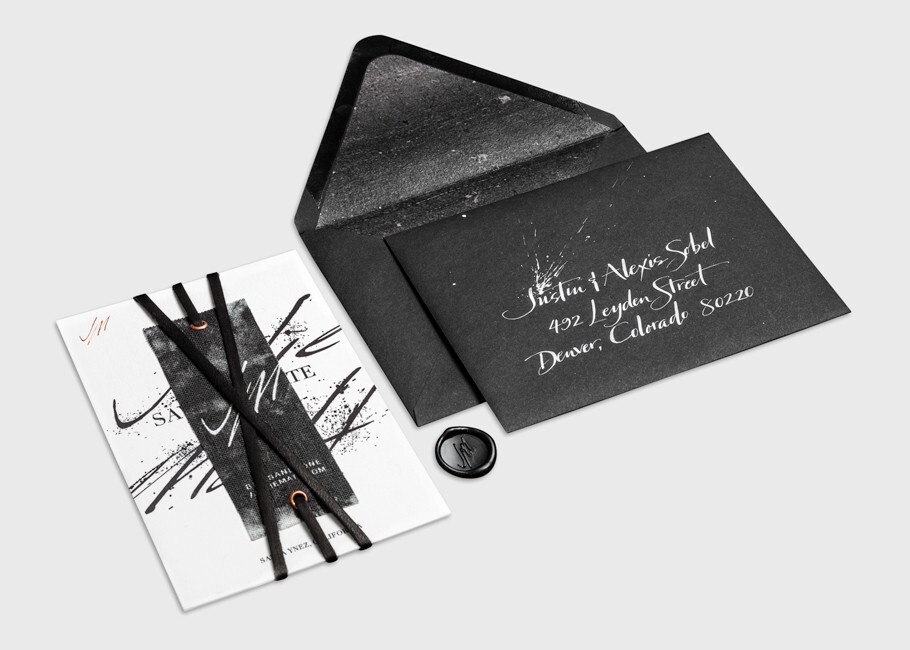
Color selection should coordinate with the invitation, not match it exactly. Common pairings: white or ivory envelope with any printed invitation, sage green or dusty blue envelope with botanical suites, blush or champagne with romantic suites, black or navy with formal or minimalist suites, kraft with rustic or destination suites. Dark-colored envelopes require white, gold, or metallic ink for addressing, since black ink on a black envelope is unreadable. Confirm ink legibility before ordering 200 addressed envelopes.
One practical note: dark or colored envelopes are entirely acceptable for mailing as long as the address is legible and the postmark is visible to the postal service. USPS sorts thousands of dark envelopes daily without issue.
Closing the envelope is the last design decision before mailing, and it ranges from purely functional to highly decorative.
Gummed and peel-and-seal adhesives are built into modern envelopes. Gummed requires moistening; peel-and-seal has a strip that peels back to reveal the adhesive. Both seal cleanly and survive postal handling without additional reinforcement. For casual and most semi-formal weddings, this is all you need.
Wax seals are the most decorative option and a popular upgrade for formal or vintage-styled suites. They can be applied to the back flap of the outer envelope (over the existing seal) or used purely decoratively on the front. Real wax (sealing wax melted and pressed with a metal stamp) looks the most authentic but is fragile in mailing. Sticker wax seals (pre-made wax disks with adhesive backing) survive mailing far better and are nearly indistinguishable visually. For an outer envelope going through the mail, sticker wax seals are the practical call.
Monogram stickers and decorative labels are a middle ground between plain adhesive and wax seals. A printed sticker with the couple's monogram or initials, applied over the seal of the flap, adds a personal touch without the fragility of real wax.
Belly bands are paper or fabric strips wrapped around the invitation suite to hold the pieces together inside the envelope. Not strictly a sealing element, but worth mentioning because they affect how the suite assembles and what the guest sees when the envelope opens.
A common etiquette question: do you seal the inner envelope? No. The inner envelope is unsealed by tradition. The entire point is that it sits inside the outer envelope already protected, and the open flap signals that the contents are ready to be handed to the recipient. Sealing the inner envelope is technically incorrect, though no one will notice if you do.
Postage is where envelope decisions translate directly into dollars. The wrong envelope choice can add $50 to $100 to your mailing cost without you realizing it until you reach the counter.
The single most important practice: take one fully assembled suite (invitation, RSVP card with return envelope, any enclosure cards, all stuffed inside the outer envelope and sealed) to your local post office. Have it weighed and measured. Confirm the exact postage required. Then buy that postage in bulk for the full guest list.
This step exists because USPS rates vary based on weight, thickness, and shape, and three details specifically catch couples off guard.
Weight. Most A7 single-card invitations come in under 1 oz and qualify for the standard First-Class letter rate. Add a thicker invitation card, RSVP card with return envelope, two enclosure cards, and a wax seal, and you are easily over 1 oz, which bumps the suite into the next rate tier (currently $0.78 plus per-ounce additions, depending on year).
Thickness. USPS allows up to ¼" thick at the standard letter rate. Thicker suites with multiple enclosures, embellishments, or ribbon ties get classified as a "non-machinable" letter or jump to the flat rate, both of which cost meaningfully more.
Shape. Square envelopes always incur the non-machinable surcharge ($0.49 per piece in 2026), even when they meet weight and thickness limits. The USPS letter-sorting machinery is built for rectangular envelopes. Squares have to be hand-sorted.
For domestic weddings, plan on $0.75 to $1.75 per outer envelope including the surcharge for any non-standard shape. For destination weddings or international guests, international postage runs $1.50 to $3.00 depending on country.
Ask the post office to hand-cancel your invitations rather than running them through automated machinery. Hand-canceling means a postal worker stamps each envelope by hand instead of running it through the mechanical canceller, which protects fragile elements like wax seals, embossing, or thick paper. Hand-canceling is free at most post offices but requires advance arrangement. Call ahead.
For broader timing on when to actually drop the envelopes in the mail, when to send save the dates first, and how the full stationery calendar shapes up, see when to send wedding invitations.
Once you have the envelopes, you need to get the addresses onto them. Three approaches, each with different tradeoffs.
Digital printing is the modern default. The address is typeset in the same font family as the invitation, sent to a printer (yours, a print shop, or your stationery supplier), and printed directly onto the envelope. Cost runs $0.50 to $2.00 per envelope depending on vendor. Pros: fast, consistent, error-free as long as your address list is clean. Cons: requires a printer that can handle envelope feeding without jamming, and ink can smear on coated or textured papers.
Hand calligraphy is the traditional choice and remains the gold standard for formal weddings. A professional calligrapher receives your guest list, hand-letters each envelope in ink, and returns them ready to mail. Cost runs $3 to $10 per envelope ($450 to $1,500 for a typical guest list of 150). Pros: timeless, personal, unmistakably handcrafted. Cons: expensive, slow (allow 2 to 4 weeks for completion), and you need to book early. Popular calligraphers fill up months in advance during peak wedding season.
Printed labels are the budget option. Address labels are printed at home or through a service, then applied to the envelope. Cost runs $0.10 to $0.30 per envelope. Pros: cheapest, fastest, accommodates last-minute additions. Cons: labels look less polished than direct printing or calligraphy, and they can peel or shift in transit. For casual or minimalist weddings, labels work fine. For formal weddings, they undercut the rest of the suite.
A practical hybrid: use digital printing for the outer envelope and pre-printed return address labels for the back flap. This keeps the front of the envelope looking elevated while saving time on the return address. For more on font choices for printed addresses, see wedding invitation fonts.
You need an A7 envelope, which measures 5.25" × 7.25", exactly ¼" larger than the card on both height and width. A7 is the standard envelope size for the most common wedding invitation dimension and mails at the regular First-Class letter rate.
No. Inner envelopes are a traditional touch that has largely faded from modern weddings. Use them only if your wedding is formal (black tie or equivalent), if you need to clarify exactly who in a household is invited, or if you want the added layer of formality. A single outer envelope is correct and appropriate for the vast majority of weddings.
The return address goes either on the back flap of the outer envelope (traditional and more formal) or in the upper left corner of the front (modern and equally correct). Pick one approach and apply it consistently across the full guest list. The return address should be the address where you want RSVPs sent, typically the couple's address or the host's.
No. Liners are decorative and add cost without functional value. Skip them when the envelope is already colored or textured, when the suite is minimalist, or when budget is a concern. Add them when the outer envelope is plain and you want a small design moment, or when you have a meaningful motif worth printing inside the flap.
Yes. USPS sorts dark and colored envelopes daily without issue, as long as the address is legible and the postmark is visible. Use white, gold, or metallic ink for addressing on dark envelopes. Black ink on a black envelope will not be readable.
Both are correct. Hand calligraphy is the formal traditional choice and reads as the most elevated. Digital printing is modern, fast, and indistinguishable from calligraphy at most price points. Printed labels are the budget option and work for casual weddings. The choice depends on formality, budget, and timeline.
Most modern envelopes have built-in gummed or peel-and-seal adhesives that work fine on their own. For formal or vintage-styled weddings, wax seals (real or sticker) and monogram stickers are common upgrades applied over the existing seal. Do not seal the inner envelope. It is meant to remain open by tradition.
Order 10 to 15% more envelopes than your guest count. Addressing mistakes happen, ink smears, and last-minute additions to the guest list are common. Envelopes are difficult to reorder in small quantities, so the buffer is worth the small extra cost upfront.
For a standard A7 outer envelope with a typical suite under 1 oz, the current First-Class letter rate ($0.78 in 2026) applies. Square envelopes incur a non-machinable surcharge of $0.49 per piece. Heavier suites, thicker envelopes, or oversized formats may push into higher rate tiers. Always weigh and measure a fully assembled sample at the post office before buying postage in bulk.
The outer envelope carries the guest's formal title, full name, and complete mailing address. This is what the postal service uses to deliver. The inner envelope drops the address entirely and uses a less formal version of the name. Outer: "Mr. and Mrs. James Anderson." Inner: "James and Sarah." The inner envelope is also where children's names appear when families are invited.
The standard sizes are A7 (5.25" × 7.25") for the common 5" × 7" invitation, A6 (4.75" × 6.5") for slightly smaller cards, A2 (4.375" × 5.75") for RSVP reply cards, and A9 (5.75" × 8.75") for oversized suites. A7 is the default for most modern weddings and mails at the standard First-Class letter rate.
Plain A7 envelopes run roughly $0.15 to $0.50 each, cotton or premium stock $0.75 to $2.00 each, and liners add another 10 to 20%. Addressing is the bigger variable: digital printing is $0.50 to $2.00 per envelope, hand calligraphy $3 to $10. Order 10 to 15% extra to cover mistakes and late additions.
The envelope is part of the suite, not an accessory to it. The right choice coordinates with the invitation in color, texture, weight, and tone. Mismatched envelopes (a heavy letterpress invitation in a thin generic envelope, or a casual modern card in a formal cotton envelope) undercut the entire impression.
For most couples, this decision is made automatically when ordering through a stationery supplier that pairs envelopes with invitation designs. The supplier's coordinated collection ensures the envelope weight, color options, and flap style coordinate with the invitation paper and printing technique. Custom suites built from scratch require more attention. The envelope should be ordered in the same paper family as the invitation card, at a comparable weight, in a color that complements the printed design without competing with it.
For formal weddings, consider upgrading to a heavier-weight envelope (100 lb+) in cotton or premium cardstock, paired with a letterpress wedding invitation or foil-printed card. The tactile difference is meaningful and reads as considered.
For modern weddings, plain white or off-white A7 envelopes with clean digital address printing pair well with minimalist wedding invites designs. The envelope's job here is to disappear into the suite, not assert itself.
For destination, garden, or outdoor weddings, kraft, sage, dusty blue, or earth-toned envelopes coordinate naturally with botanical, illustrated, or watercolor invitation styles.
When in doubt, order wedding paper samples before committing to a full order. Holding the envelope alongside the invitation paper gives you a clearer sense of pairing than any preview screen will.
Every decision in this guide (sizes, addressing, liners, sealing, postage) exists because of the physical envelope itself. Couples who send online wedding invitations skip all of it.
Digital invitations deliver by email, SMS, or shareable link. There is no envelope to address, no postage to calculate, no calligrapher to book, no liners to assemble. The invitation arrives on a guest's phone or in their inbox, and RSVPs come back through the invitation itself. For couples managing a large guest list or working within a tight timeline, the workflow advantage is meaningful.
Many couples send both. Digital invitations to most of the guest list, printed wedding invitations with full envelope treatment to a smaller subset like older family members, formal events, or guests for whom physical mail carries more weight. Coordinating both formats across the same design collection means the suite reads as intentional regardless of which version each guest receives.
For more on the conventions that connect every piece of the suite, including wording, timing, and addressing, see the broader wedding invitation etiquette guide. When you are ready to choose your invitation design, browse the full collection at online wedding invitations or explore the printed wedding invitations collection for designs built to pair with envelopes that match.