



Start Designing for Free!
By Bliss & Bone
June 2026
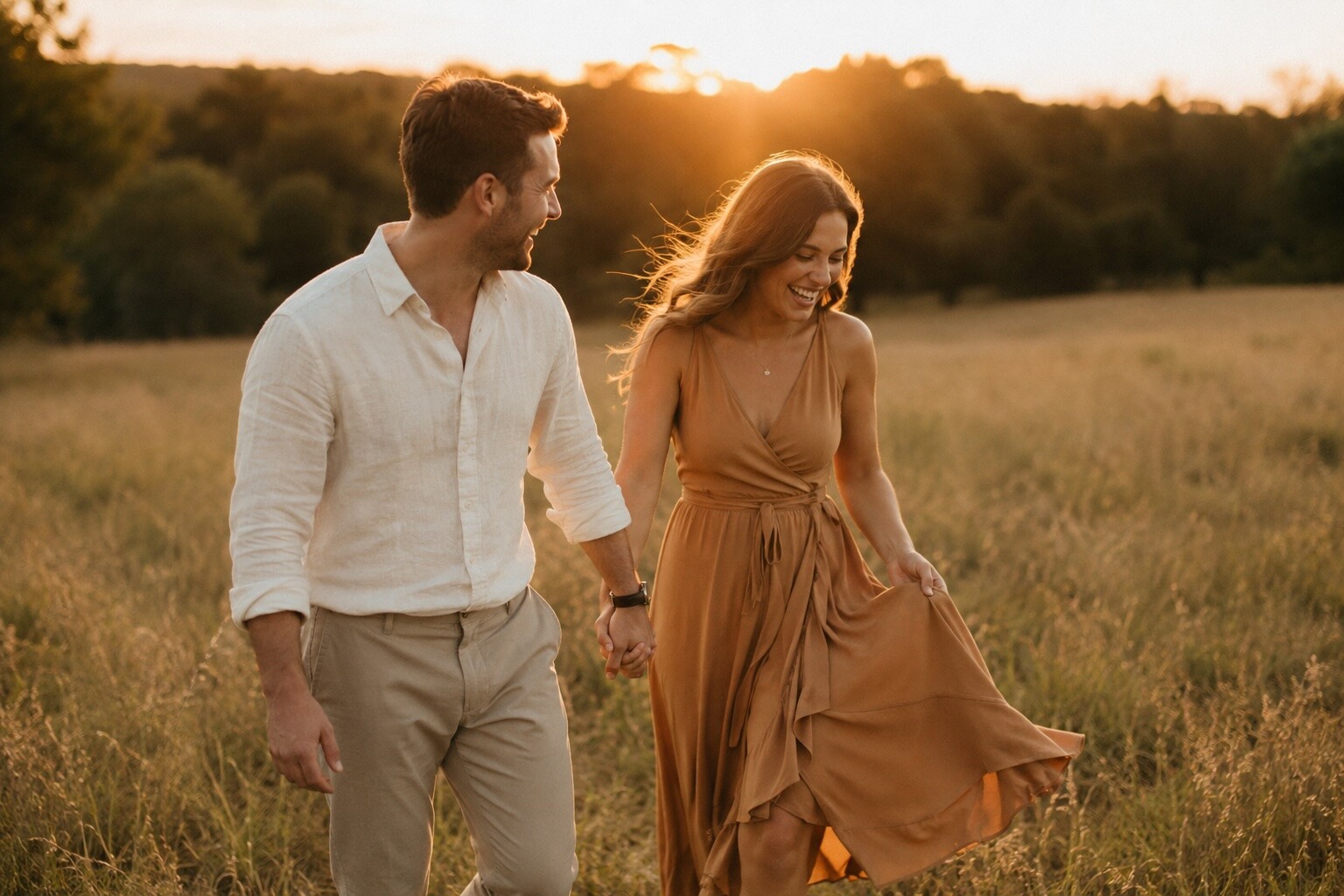
Engagement photos are a portrait session a couple books after getting engaged and before the wedding, usually to capture the two of you together and to supply images for save-the-dates, your wedding website, and the wedding-day décor. Most couples shoot three to six months out, pay anywhere from a few hundred to a few thousand dollars depending on the photographer, and walk away with 30 to 75 edited images. This guide covers the full plan: when to book, what to wear, how to pose if you've never been in front of a camera together, what the session costs, and where the photos actually live once you have them.
The session matters more than the inspiration boards suggest. Your engagement photos become the first visual your guests see of you as an engaged couple, on the save-the-date that lands in their mailbox and on the wedding website they open to RSVP. Getting the planning right is the difference between images you use everywhere and a folder you never open again.
The planning itself follows a simple order, and doing it in sequence saves the most stress. Lock your save-the-date timeline first, because it sets your hard deadline. Book the photographer next, since the best ones fill up months ahead and their calendar shapes your date. Then choose your season and location together, since those decide the palette. Pick your outfits last, around the location and light rather than in a vacuum. The rest of this guide walks each step in that order.
Book your engagement session three to six months before the wedding if the photos are going on save-the-dates, and shoot earlier rather than later. Save-the-dates go out six to eight months before the wedding, so you need edited images in hand before that mailing. Working backward, an early-fall shoot supports a winter save-the-date; a spring shoot supports a late-summer one.
Timing also depends on the look you want. Golden hour, the window roughly an hour after sunrise or before sunset, gives the soft, directional light most couples are after, so build the session around the light rather than your calendar. That window shifts dramatically by season: a June golden hour can fall after 7:30 p.m., while a December one lands closer to 4 p.m. Ask your photographer for the exact start time for your date and location, and arrive fifteen minutes early so you're settled before the best light hits.
Season drives more than light. Spring and fall are the most forgiving for both weather and wardrobe, which is why photographers book up fastest in those months, often eight to twelve weeks out in peak season. Summer delivers long evenings but demands a heat-friendly wardrobe and a willingness to wait until late for soft light; winter offers dramatic bare-tree and snow backdrops but a short shooting window and real cold to dress around. If you want a specific seasonal backdrop, blooming trees, fall foliage, fresh snow, reserve your date well ahead, because peak bloom and peak color last only a week or two.
Build a weather backup into the plan from the start. Outdoor sessions get rained out, and the couples who handle it best agree on a rain-date or an indoor alternative (a library, a hotel lobby, a greenhouse, your own home) before the forecast forces a last-minute scramble. Confirm your photographer's reschedule policy when you book.
Decide, too, between a full session and a mini session. A full one-to-two-hour session gives you multiple locations, an outfit change, and 30 to 75 edited images. A mini session, usually 20 to 30 minutes for a lower flat rate, covers one location and one look and works well if the photos are a bonus rather than the centerpiece. For save-the-date use, the full session is the safer choice because it gives you options.
There's no rule that says engagement photos have to tie to the wedding at all. Plenty of couples shoot within a month or two of getting engaged, before the planning ramps up, simply to mark the moment. If you're still in the early-decisions phase, our guide to what to do after getting engaged lays out the first steps in order, and you can see how your shoot fits the broader runway in our breakdown of the average engagement length.
The wardrobe goal is to look like the best, most coordinated version of yourselves, not a costume. Choose outfits that complement rather than match: one of you in a pattern or a soft pop of color, the other in a neutral that doesn't compete. Cream, olive, navy, camel, and soft earth tones photograph beautifully in natural settings, while loud reds and busy prints pull the viewer's eye to the fabric instead of your faces.
Dress for the season and the location. Flowing fabrics read well in open fields and on beaches because they catch movement; structured pieces and richer textures suit urban and architectural backdrops. The single most common regret is choosing an outfit that looks great on a hanger but feels wrong on your body, so wear something you'd genuinely feel confident in on a date night.
This is the part of planning couples agonize over most, so it gets its own full guide covering wardrobe by season, by location, the white-dress question, coordinating two looks, and what to avoid. For the deep version, see the complete guide to what to wear for engagement photos.
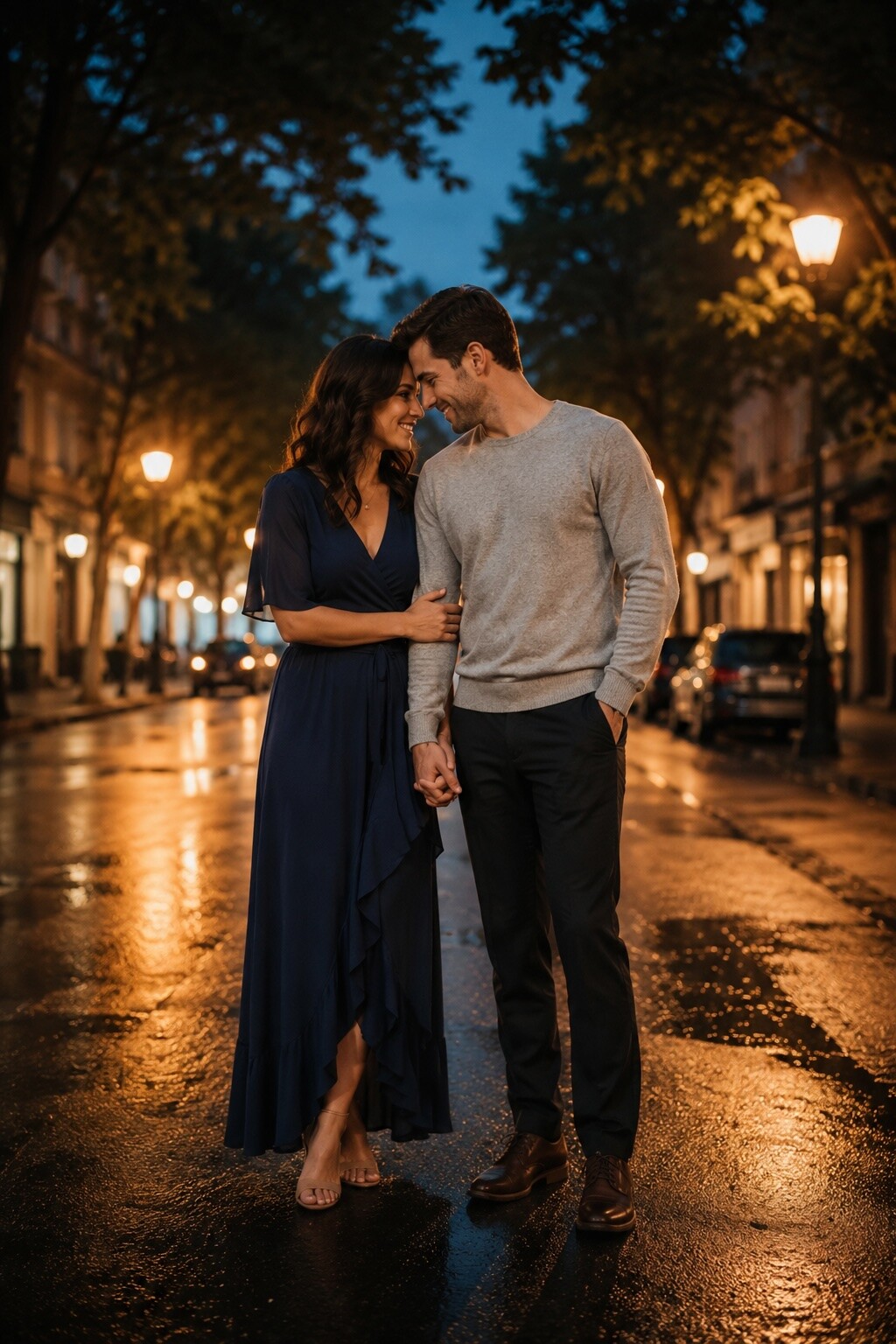
The setting sets the entire mood of the shoot, so choose it before you choose your outfits. A beach delivers airy, romantic frames; an urban backdrop reads modern and editorial; a field or forest leans natural and documentary; your own home produces the most intimate, lived-in images of the bunch. Seasonal settings carry their own built-in palette, with fall foliage, spring blossoms, and fresh snow doing half the styling work for you.
Beyond location, your photos take on a vibe based on how you direct the session: candid and documentary, classic and timeless, or playful and movement-driven. The couples who love their galleries most usually pick one location that means something to them, a first-date spot, a favorite hiking trail, the neighborhood they live in, rather than the prettiest place on a Pinterest board.
For setting-by-setting breakdowns and seasonal galleries, see the full guide to engagement photo ideas by setting and vibe.
If you feel stiff in front of a camera, the fix is motion, not a pose chart. Walk together, swing your joined hands, pull each other in close, whisper something that actually makes the other person laugh. Real movement and real conversation produce the natural expressions that posed smiles never will, which is why most modern photographers shoot in a documentary style that captures you between the prompts rather than during them.
A few reliable starting points: face each other forehead to forehead with your eyes closed, walk toward the camera mid-conversation, or have one partner whisper while the other reacts. The trick is to focus on each other instead of the lens. "The best engagement photos happen in the half-second after a prompt ends, when the couple forgets the camera is there," notes the Bliss & Bone editorial team. Nearly every top-ranking page on this topic centers the same anxiety, that you're not models, so treat the session as a date that happens to be photographed and the poses take care of themselves.
A downloadable shot-list and prompt checklist, the kind you can hand your photographer, lives at the bottom of this guide.
Once you have the gallery, the captions write themselves if you keep them short and specific. The strongest engagement captions name the feeling or the moment rather than reaching for a generic quote: a date ("6.7.26"), a one-liner ("Turns out forever starts now"), or an inside joke only your people will catch. Pair one standout image with one tight line and let the photo carry the rest.
If the post is the formal reveal rather than a follow-up, the wording deserves a little more thought, and the announcement itself follows its own etiquette. Our guide to how to announce your engagement covers timing, who to tell first, and wording for the post itself. The same gallery also fuels your engagement party invites and décor, so shoot with those uses in mind.
Engagement photo pricing spans an enormous range, so the honest answer is that it depends heavily on who you hire. A short session with a newer photographer can run a few hundred dollars, while an established or in-demand name, especially in a major market, can charge several thousand, and the most sought-after wedding photographers go well beyond that. A common mid-market reference for a standalone one-to-two-hour session lands around $300 to $800, but treat that as a starting point, not a ceiling. What you pay reflects the photographer's experience and demand, session length, location and travel, the number of edited images, and whether you receive full print rights. Many wedding photographers fold an engagement session into their wedding package at no extra charge, so if you've already booked your wedding photographer, ask before hiring separately, since that single question saves some couples the entire standalone fee.
Because published rates vary so widely even within a single city, the only reliable way to know what a specific photographer charges is to ask them directly and request a full price list.
Before you pay, confirm what's actually included: the number of edited high-resolution images, the turnaround time, whether you receive a print release, and any travel fees for a location outside the photographer's home base. A low session fee with a small image count or a six-week turnaround can cost you more than a higher all-in rate, especially when a save-the-date deadline is looming.
When you're ready to book, the fastest way to compare portfolios and styles in your area is to browse engagement and wedding photographers on Carats & Cake, where you can shortlist by aesthetic and location in one place. Look for a consistent body of work in the style you actually want, documentary versus classic versus editorial, rather than a single standout image, since a photographer's worst gallery tells you more than their best. Read recent reviews, confirm they've shot your type of location before, and ask three questions before signing: how many edited images you'll receive, what the turnaround time is, and whether they bring backup gear.
Tipping is optional and never expected for a studio owner setting their own rates, but a gratuity of $50 to $100, or a warm review and a tagged social post, is a genuine kindness for a session you loved. If the photographer is a second shooter or an employee of a larger studio, a tip is more customary.
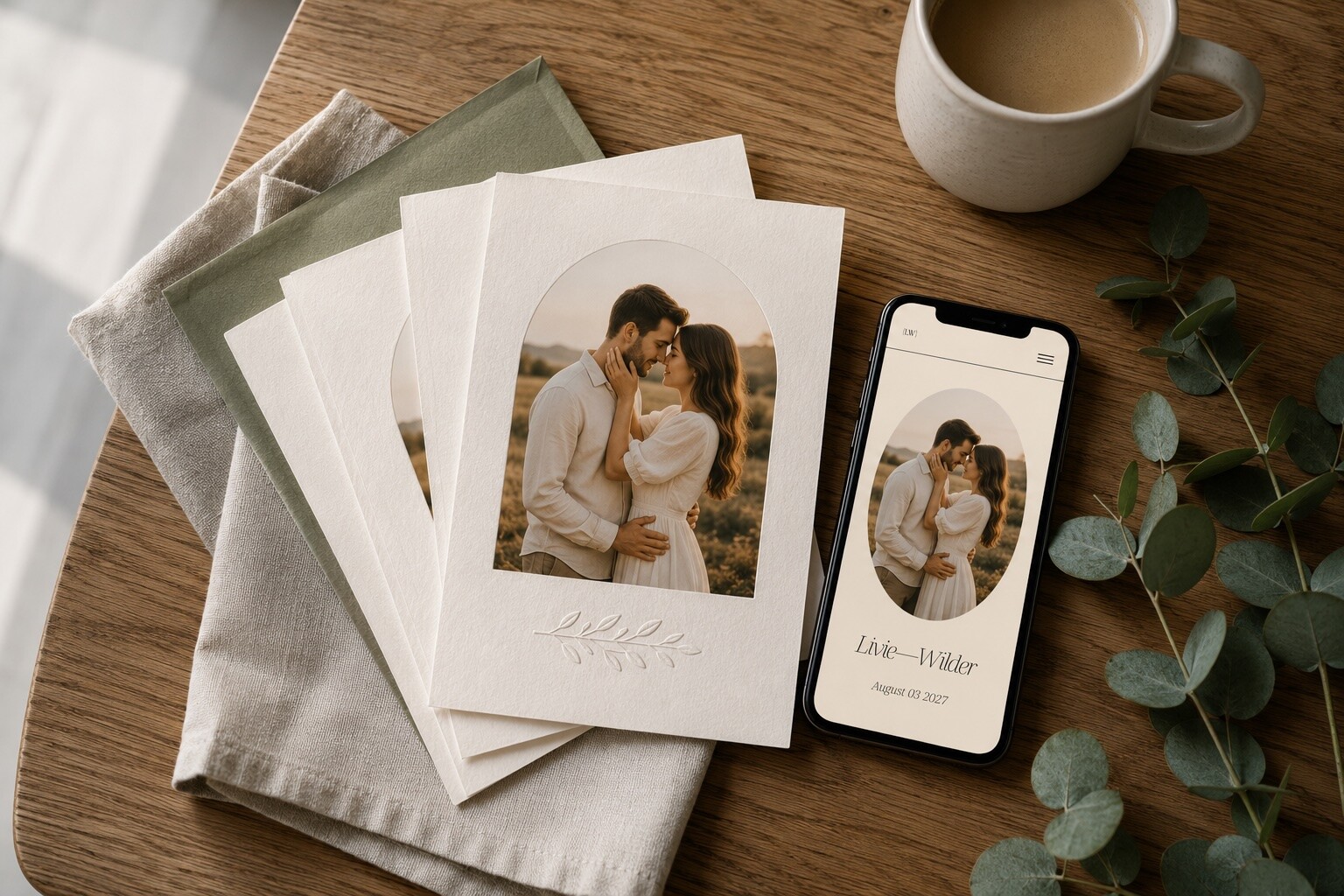
Engagement photos exist to be seen, and the two highest-impact places to use them are your save-the-dates and your wedding website. A photo save-the-date puts your favorite frame straight into your guests' hands and sets the visual tone for every paper piece that follows. It's the first impression of your wedding, and a strong engagement image does more work there than any design flourish.
The longest-living home for the full gallery is your wedding website, where guests return again and again to check details and RSVP. Build a free wedding website and your best engagement photos become the backdrop your guests see every time they visit, instead of sitting in a folder on your phone. Lead with the images you love most, then let the practical details follow.
The gallery keeps working long after the save-the-dates mail. Couples pull engagement photos into the guest book or sign-in album, blow one up as reception décor or a welcome-table portrait, print a favorite for thank-you cards after the wedding, and reuse the seasonal frames for the holiday card that doubles as a quiet announcement. Shoot with these uses in mind: vary your framing so you come away with both tight portraits for paper goods and wider, horizontal frames that work as website headers and large prints. A gallery built only of close-ups leaves you short when you need a banner image.
One practical note on file management. Ask your photographer for both web-resolution and print-resolution files, and keep the print files backed up in two places. The web versions load fast on your wedding website; the print versions are what you'll need months later for a 16-by-20 canvas or a card order, and they're easy to lose track of once the excitement fades.
Take them three to six months before the wedding if you're using the images for save-the-dates, since those mail six to eight months out and you need time to edit and print. If the photos aren't tied to the wedding, any time after the proposal works, and many couples shoot within a month or two to capture the excitement early.
No, they're optional, but they're useful well beyond sentiment. The gallery supplies images for your save-the-dates, wedding website, guest book, and reception décor, and it gives you and your photographer a low-stakes trial run together before the wedding day. Couples who skip them most often wish they had a strong recent photo of just the two of them.
Most sessions run one to two hours, which is enough time for one or two outfit changes and a couple of locations without feeling rushed. Booking around golden hour, just after sunrise or before sunset, gives you the best light for the bulk of that window.
Two outfits is the sweet spot for a standard one-to-two-hour session: one dressed-up look and one relaxed, everyday look. More than two eats your shooting time with changes, and the variety rarely improves the final gallery as much as good light and a location you love.
Golden hour, the period shortly after sunrise or just before sunset, gives the soft, warm, flattering light most couples want. Midday sun creates harsh shadows and squinting, so if a midday slot is unavoidable, ask your photographer to shoot in open shade.
Most photographers deliver 30 to 75 edited images from a one-to-two-hour session, though the exact number varies by photographer and package. Confirm both the count and the turnaround time before booking, especially if the images need to make a save-the-date deadline.
Pricing varies enormously, from a few hundred dollars for a newer photographer to several thousand for an established or in-demand name, with the most sought-after photographers charging more still. A common mid-market range for a standalone one-to-two-hour session is around $300 to $800, but treat that as a reference point rather than a cap. Many wedding photographers include the session free with a wedding package, so ask before hiring separately.
A tip is optional and not expected for a studio owner who sets their own rates, though a $50 to $100 gratuity is a kind gesture after a session you loved. A glowing review and a tagged social post carry real value for a small business and cost nothing. Tipping is more customary when your photographer is a second shooter or an employee rather than the owner.
You can, and a tripod, a phone or camera with a self-timer or remote, and golden-hour light will get you usable images for a casual announcement. The tradeoff is that you lose a second set of hands, real-time direction, and the polish of professional editing, which matter most when the photos are headed for printed save-the-dates. A middle path is a short mini session, which delivers professional results for a lower flat rate than a full shoot.