



Start Designing for Free!
By Bliss & Bone
May 2026
A wedding invitation suite is the complete set of coordinated cards a couple sends to guests in a single envelope. At minimum, that's the invitation itself, an RSVP card, and a details card. Add envelopes, a belly band, a vellum wrap, or additional enclosure cards and the suite grows from there. The point of a suite, as opposed to a single invitation, is that every piece works together — same typography, same color palette, same paper stock, so guests open the envelope and see one cohesive design instead of a card with a few loose accessories.
This guide covers what's included at every tier, what each card actually says, how digital and printed suites differ, and the exact order to stack everything when you're assembling. If you already know what you're looking for, browse printed wedding invitations to see complete suites from Bliss & Bone, or online wedding invitations for the digital equivalent.
These are different things, and the distinction matters once you start ordering.
A wedding invitation suite is everything that fits inside the envelope you mail to guests roughly six to eight weeks before the wedding. That's the invitation, the RSVP, and any enclosure or details cards needed to communicate the essentials. It's a single mailed package, and every piece in it has one job: get guests to the right place at the right time with the right information.
A wedding stationery suite is the broader collection of paper used across the entire wedding weekend. That includes save the dates (sent months earlier), the invitation suite itself, day-of pieces (menus, programs, place cards, escort cards, table numbers, signage), and post-wedding pieces (thank you cards). The stationery suite typically gets designed as one cohesive system across the full wedding, but it's ordered in waves as each piece is needed.
When couples ask "what's included in our invitation suite," they're asking about the envelope contents. When stationers refer to the "stationery suite," they mean the whole weekend's printed identity. Keep the two straight when you're talking to a designer or printer.
Every suite has three core pieces. Everything else is optional and added only when it serves a purpose.
The invitation. The main card. Carries the host line, the couple's names, the ceremony date and time, the ceremony venue, and (if reception is at the same location) a "reception to follow" line. This is the largest card in the suite and the one that sets the visual identity for everything else. For ready-to-use wording, see the full guide to wedding invitation wording.
The RSVP card. Asks guests to confirm attendance by a specific date. Modern RSVP cards also collect meal choice, dietary restrictions, and sometimes a song request. The card itself is smaller than the invitation (typically A2 or 4-Bar), and it's traditionally paired with a pre-addressed, pre-stamped response envelope so guests can mail it back without effort. For wording examples across formal and casual events, see the wedding RSVP wording guide.
The details card. Sometimes called an enclosure card or information card. Carries everything that doesn't fit on the main invitation: reception venue if it's separate from the ceremony, dress code, hotel block information, transportation details, and the wedding website URL. The details card is what saves the main invitation from looking cluttered.
That's the standard three-card suite, and for many weddings, that's all you need.
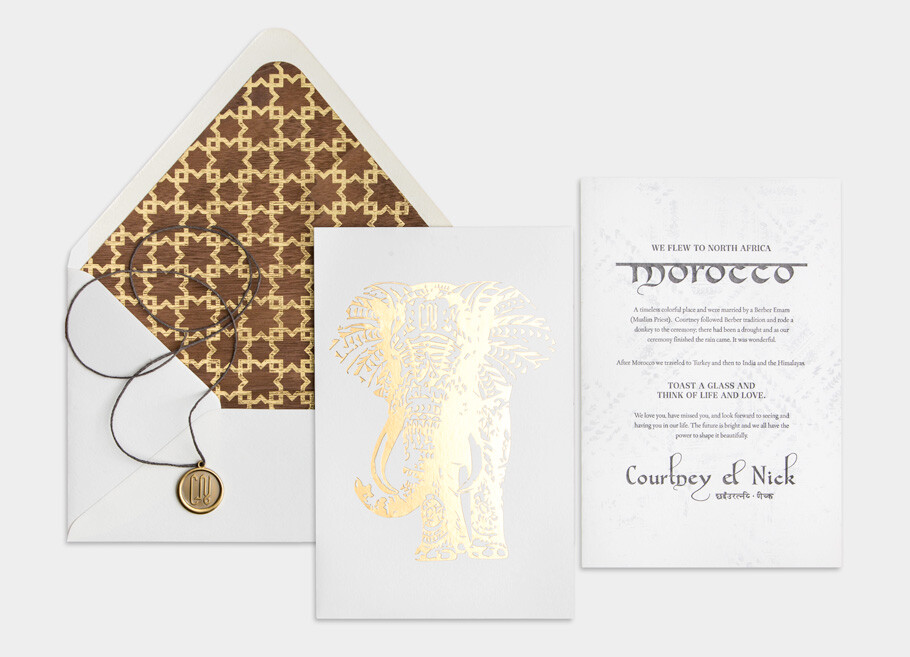
Beyond the core three, every additional piece serves a specific function. Add them when the function applies. Skip them when it doesn't.
Reception card. A separate card dedicated to reception details when the reception is at a different venue from the ceremony. Includes the reception venue name, address, and time. Couples whose ceremony and reception are at the same location don't need this. A single "reception to follow" line on the main invitation does the work.
Accommodation card. Lists hotel blocks, room rates, and booking codes. Especially useful for destination weddings or wedding weekends where most guests are traveling. For local weddings with few traveling guests, this information lives more comfortably on the wedding website.
Map or directions card. Useful for rural venues with poor GPS coverage, multi-venue weddings where guests need to navigate between locations, or destination weddings where local landmarks help orient guests.
Rehearsal dinner invitation. When the rehearsal dinner guest list is small and the host wants to include it in the main mailing rather than send a separate envelope, the rehearsal dinner invitation can ride along inside the main invitation envelope. Only include this in invitations going to guests who are actually invited to the rehearsal dinner. For wording, see the rehearsal dinner invitation wording guide.
Response envelope. A small envelope, pre-addressed to the host and pre-stamped, that holds the completed RSVP card. Traditional and expected for formal printed suites. Many modern couples skip this and direct guests to RSVP through their wedding website instead, which removes a printing cost and a stamp.
Inner envelope. A second, unsealed envelope inside the outer mailing envelope that holds the entire suite. The outer envelope carries the address and postage; the inner envelope carries the guests' names only. This is a traditional touch that's become less common, though it remains correct etiquette for very formal weddings. For full naming conventions, see how to address a wedding invitation.
Belly band. A narrow paper or vellum band wrapped around the assembled suite to hold the cards together when guests open the envelope. Decorative, but functional: it prevents the suite from arriving as a loose stack.
Vellum wrap. A translucent vellum sheet that wraps the front of the invitation, often printed with the couple's names or a monogram. Adds visual layering and protects the invitation surface during mailing.
Wax seal. Applied to the outer envelope flap or used to fasten the belly band or vellum wrap. Wax seals signal a formal, traditional suite and pair well with letterpress printing and cotton paper. They're not appropriate on every suite, but on the right one they're the detail guests notice first.
Envelope liner. Patterned or colored paper that lines the inside of the outer envelope. The first thing guests see when they open the envelope. Often coordinates with a design motif used elsewhere in the suite.
Suites scale based on how complex the wedding logistics are. Three useful reference points:
Three-piece suite. Invitation, RSVP card, details card. The standard for most weddings where ceremony and reception are at the same venue and guests aren't traveling far. Clean, focused, and the most cost-effective option without sacrificing anything important.
Five-piece suite. Adds a reception card (when reception is at a separate venue) and a response envelope (pre-addressed and stamped for the RSVP). The right call for traditional weddings, formal celebrations, or events where ceremony and reception are at different locations.
Seven-piece suite. Adds an accommodations card and an inner envelope, or substitutes a map/directions card depending on the venue. Standard for destination weddings, wedding weekends, and very formal events where every additional touch reinforces the overall identity.
A suite with more than seven pieces is rare and almost always indicates that something should have moved to the wedding website instead. The job of the suite is to communicate the essentials, not the entire wedding weekend itinerary.
The single most useful thing to know about an invitation suite is what each card is supposed to communicate. Couples often duplicate information across cards or leave essential details off entirely, and both create friction for guests.
The invitation carries the host line, the couple's full names, the ceremony date spelled out in full, the ceremony time spelled out in full, the ceremony venue name and city, and (for same-venue weddings) a "reception to follow" line. That's it. Dress code, hotel information, and the wedding website URL do not belong on the main invitation.
The RSVP card carries the reply-by deadline, a name line, response options (accepts/declines), and any additional information collection you need from guests: meal choice, dietary restrictions, song request. Three to four weeks before the wedding is the standard RSVP deadline. For full guidance, see the wedding RSVP deadline guide.
The details card carries reception venue and address (if not on the main invitation), dress code, hotel block information, transportation notes, and the wedding website URL. Anything that doesn't fit cleanly on the invitation or RSVP belongs here. Keep it readable: a details card with eight separate sections becomes a paragraph guests skip.
The reception card (when included as a separate piece) carries the reception venue, address, and time. Nothing else.
The accommodations card carries hotel name(s), address, booking code, room rate, and reservation deadline. Same rule: nothing else.
The suite concept applies to both formats, but the mechanics differ.
A printed suite is a physical mailing. Every card listed above prints separately, the assembly is manual, and the suite ships in a single outer envelope with calligraphy or printed addressing. Cost scales with the number of pieces, the print method (digital, letterpress, foil), the paper stock, and any add-ons like wax seals or envelope liners. Production lead times run two to four weeks for digital print and four to six weeks for letterpress or foil.
A digital suite delivers the same content electronically. Guests receive the invitation by email, SMS, or a shareable link, and the additional "cards" become sections of the same invitation or links to the wedding website. The RSVP doesn't need a separate response envelope because guests respond directly through the invitation, and responses populate a dashboard automatically. The details card content typically moves to the wedding website, which the digital invitation links to. There's no physical assembly, and updates can be pushed to guests after sending at no additional cost.
Many couples send both: a digital suite to most of the guest list and printed invitations to older guests or for whom paper feels more appropriate. The two coordinate cleanly when both are designed from the same collection. Bliss & Bone coordinates digital and printed suites across the same design system, so the visual identity holds whether the suite arrives by email or by post.
Assembly order matters. When guests pull the suite out of the outer envelope, the invitation should be facing them first, with smaller cards stacked logically behind it. The standard assembly works from bottom to top:
Start with the largest piece on the bottom, which is the invitation itself, face up. Next, the reception card if you're using one, placed face up directly on top of the invitation. Then the details card, also face up. Then the RSVP envelope, flap down with the printed return address visible, with the RSVP card tucked under its flap face up. Any additional pieces (accommodations card, map, rehearsal dinner invitation) sit between the details card and the RSVP envelope, with the smallest pieces toward the top of the stack.
If you're using a belly band or vellum wrap, it goes around the entire stack at the end, securing the pieces together. The assembled stack goes into the inner envelope (if you're using one) with the invitation facing the back of the envelope, so guests pull the stack out and see the invitation immediately. The inner envelope then goes into the outer mailing envelope.
The same logic applies in reverse for a digital suite: the invitation loads first, with details and RSVP accessed through the same flow. No physical stacking required, but the hierarchy of what guests see first still matters.
Printed suite costs scale with three variables: print method, paper stock, and number of pieces.
Digital print on standard cardstock for a three-piece suite typically runs $3 to $7 per suite for orders of 100 or more, before envelopes and postage. Letterpress and foil printing on premium paper stocks raise the per-suite cost to $12 to $25 or higher, again before envelopes and postage. Add-ons like wax seals, envelope liners, and vellum wraps each add $0.50 to $2 per suite. Postage for a three-piece suite typically requires one standard stamp ($0.73 as of 2026), but oversized envelopes, square envelopes, or thicker suites with seven or more pieces often require additional postage, which can push mailing costs to $1.50 or more per envelope.
Digital suites are priced per recipient. Bliss & Bone digital invitations are $0.90 per recipient, which includes RSVP tracking, automatic reminders, and the ability to update event details after sending. For a 150-guest wedding, that's roughly $135 to send the entire digital suite, versus $750 to $4,500 for the printed equivalent depending on print method and add-ons.
The cost gap is part of why most couples now send both: digital to the majority of the list (faster, cheaper, automatic RSVP) and printed to a smaller portion (parents, older relatives, anyone for whom paper feels expected).
Suite style is a function of three things: the wedding's overall aesthetic, the venue, and the formality level. Match all three and the suite reads as intentional. Mismatch any of them and the suite looks like it was chosen in isolation from the wedding itself.
Classic and formal suites use serif typography, restrained color, and traditional layouts. They pair with black-tie events, hotel ballrooms, country clubs, and church ceremonies. The right call when the wedding's overall identity is elevated and consistent across every detail.
Modern and minimalist suites use clean sans-serif or modern serif typography, generous white space, and limited color. They pair with contemporary venues, downtown ceremonies, and couples whose visual identity is restrained and design-forward.
Floral and botanical suites use illustrated botanicals, watercolor accents, or pressed-flower motifs. They pair with garden weddings, vineyard celebrations, and outdoor receptions where the natural setting is part of the experience.
Letterpress and foil suites are defined by print technique rather than visual style. Letterpress impresses the design into thick cotton paper; foil adds metallic shine. Both signal craft and quality, and both pair with formal weddings where the physical impression of the stationery is part of the occasion. See letterpress wedding invitations for the full range.
Destination and tropical suites use warm color palettes and illustrated landscapes that signal the setting before guests even arrive. They pair with beach weddings, vineyard celebrations, and weddings in identifiable destinations where the location is part of the invitation.
Browse wedding invitation ideas for design inspiration across every style, or see wedding invitation fonts for guidance on typography pairings that hold across an entire suite.
Card sizes within a suite follow a deliberate hierarchy: the invitation is the largest, the details card is mid-size, and the RSVP card is smallest. This hierarchy is functional. Smaller cards stack neatly on top of larger ones, the envelope holds the entire suite without excess space, and the visual layering reads as intentional when guests open the envelope.
Standard sizing: the invitation typically prints at A7 (5x7 inches), the details card at A6 or A7 (4.5x6.25 or 5x7 inches), and the RSVP card at A2 or 4-Bar (4.25x5.5 or 3.5x4.875 inches). Square invitations and oversized A9 invitations exist and look striking, but they require non-standard envelopes and often additional postage. For full guidance on every size option and how sizes affect mailing costs, see the wedding invitation size guide.
Envelope choice should be confirmed alongside card sizes, not after. A square invitation paired with a standard rectangular envelope creates a mailing problem that's easy to avoid at the design stage.
The strongest invitation suites are defined as much by what they don't include as by what they do.
Registry details don't belong in the suite. Direct guests to the wedding website for registry information; printing it on a card reads as a request for gifts rather than an invitation to celebrate.
A detailed wedding weekend itinerary doesn't belong in the suite. Save welcome events, post-wedding brunches, and minute-by-minute schedules for the wedding website or a printed welcome packet handed out at the hotel block.
Personal stories, how-we-met narratives, and lengthy thank-yous don't belong in the suite. The invitation suite is functional documentation, not a scrapbook. Save those for the wedding website's "Our Story" section, where guests can read them at their own pace.
Adult-only or no-children language doesn't belong on the invitation. The cleanest way to communicate a child-free wedding is through the wedding website and through the addressing itself. List only the adults' names on the inner envelope and the absence of children's names signals the policy. See how to address a wedding invitation for the full conventions.
The general rule: if the information is essential to getting guests to the right place at the right time, it belongs in the suite. Everything else belongs on the wedding website.

At minimum, the invitation, an RSVP card, and a details card. Most couples add a response envelope (pre-addressed and stamped for the RSVP) and, for traditional formal events, an inner envelope and a reception card if the reception is at a separate venue. Decorative touches like belly bands, vellum wraps, wax seals, and envelope liners are optional and depend on the formality level.
A wedding invitation is a single card. A wedding invitation suite is the full set of coordinated cards that ship together in one envelope, typically including the invitation, an RSVP card, and a details card. The suite communicates everything guests need to know about the wedding; the invitation alone is just the announcement.
Three to five pieces is the most common range. Three-piece suites include the invitation, RSVP card, and details card. Five-piece suites add a response envelope and a reception card. Larger suites of seven or more pieces are most common for destination weddings, wedding weekends, and very formal events where additional cards serve a specific function.
The invitation suite is what goes into a single envelope mailed to guests roughly six to eight weeks before the wedding. The stationery suite is the broader collection of printed pieces used across the full wedding weekend, including save the dates, the invitation suite itself, day-of pieces (menus, programs, place cards, signage), and post-wedding thank you cards.
A details card is useful any time the main invitation can't carry all the essential information without becoming cluttered. Reception at a different venue, dress code, hotel block information, transportation, and the wedding website URL are common details-card content. If the ceremony and reception are at the same venue and the rest of the information lives on the wedding website, a details card may not be necessary.
Yes. A digital wedding invitation suite delivers the same content as a printed suite (invitation, RSVP, details) through email, SMS, or a shareable link. The RSVP collects directly through the invitation rather than a mailed response card, and the details card content typically lives on the connected wedding website. Bliss & Bone coordinates digital and printed suites across the same design system, so couples can send both formats with consistent visual identity.
Stack the invitation on the bottom, face up, followed by the reception card (if used), details card, and any additional enclosures with the smallest cards toward the top. The RSVP envelope sits on top of the stack, flap down, with the RSVP card tucked under the flap. If using a belly band or vellum wrap, secure the entire stack with it. Insert into the inner envelope (if used) with the invitation facing the back, then into the outer mailing envelope.
Registry details, lengthy wedding weekend itineraries, personal stories, and adult-only language all belong on the wedding website rather than in the printed suite. The suite's job is to communicate the essentials: who, when, where, and how to respond. Everything else creates clutter that distracts from the core information.
For a printed suite designed as a coordinated system from the invitation through every enclosure card, browse printed wedding invitations and order wedding paper samples before committing to a final design. For a digital suite with built-in RSVP tracking and a matching wedding website, online wedding invitations deliver the same coordinated identity at a fraction of the cost. Many couples send both formats from the same design collection. The suite arrives in two ways, looks intentional in both, and gives every guest the right format for how they actually respond.