



Start Designing for Free!
By Bliss & Bone
May 2026
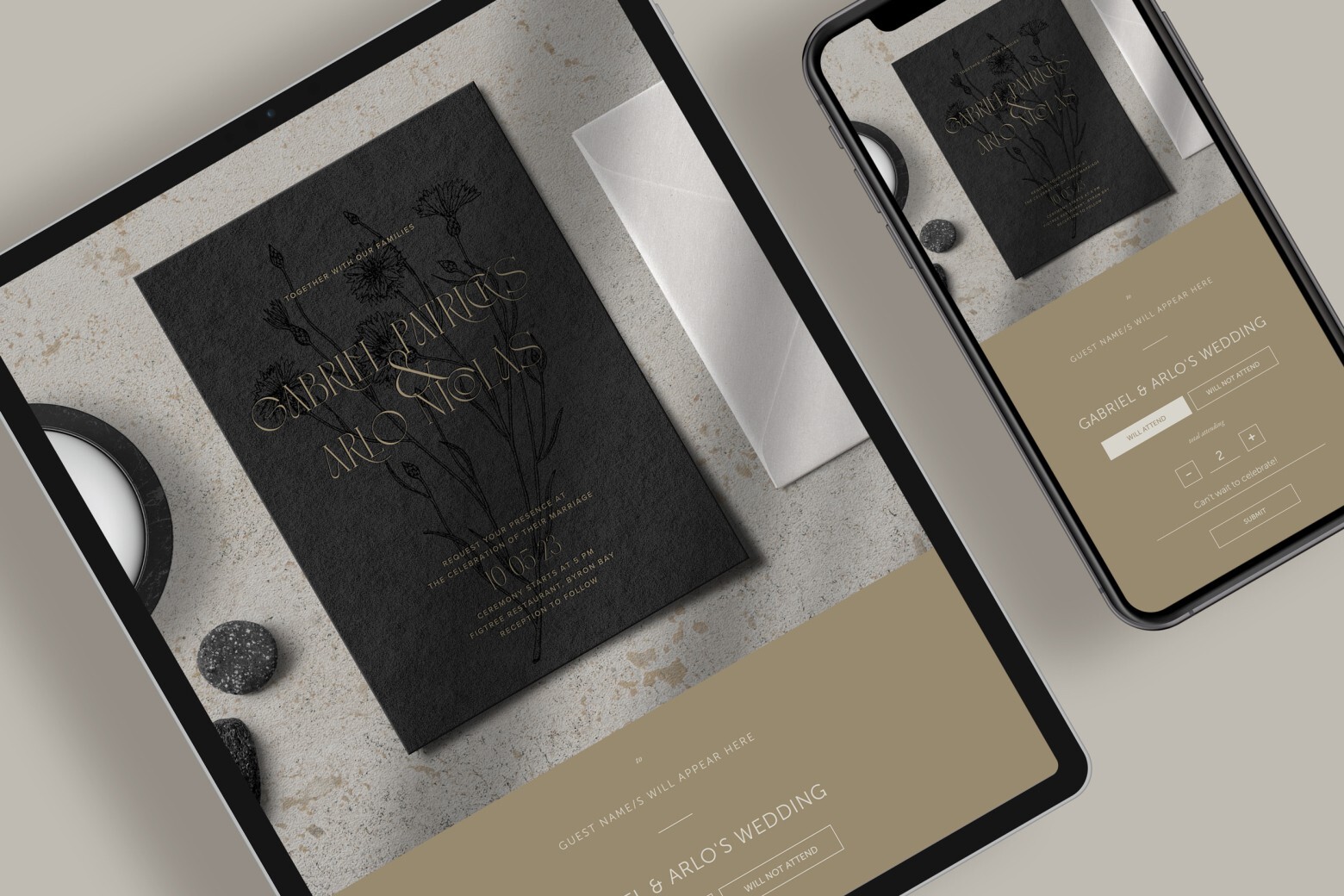
RSVP on an invitation means the host wants you to tell them whether or not you will be there. It is a request for a reply, and the invitation is not complete until you send one.
RSVP stands for the French phrase répondez s'il vous plaît, which translates to "please respond" or, more literally, "respond if you please." That four-word phrase is the full form of RSVP, and it is the entire meaning: when you see RSVP on an invitation or invitation card, the host is asking you to confirm your attendance.
The abbreviation has been used in English-language invitations since the 1800s and has stayed in use because it solves a real problem. A host planning any event, from a dinner for eight to a wedding for two hundred, needs an accurate headcount to order food, arrange seating, and stay within a venue's capacity. RSVP is the mechanism that gives them that number.
An RSVP request usually appears near the bottom of an invitation, often followed by a date and a way to reply, such as a phone number, an email address, a reply card, or a link to a wedding website. Whatever form it takes, the expectation is the same. The host is not asking if you would like to weigh in. They are asking you to answer, by a specific date, yes or no. An invitation that asks for this reply is sometimes called an RSVP invitation, whether the request is printed on the invitation itself or on a separate reply card.
An RSVP asks for three things: a clear answer, a timely answer, and any details the host needs to plan around you.
The clear answer is the core of it. RSVP is a yes-or-no question, never a "maybe" and never silence. Hosts build their plans on confirmed numbers, so a non-response is the hardest outcome to work with. If you have not decided yet, it is better to give your best honest answer by the deadline than to leave the line blank.
The timely answer matters because the host's other decisions depend on yours. Caterers, venues, and rental companies all work from final counts, and most of those counts are due well before the event. Replying close to the deadline, rather than after it, keeps the host from having to chase you down during the busiest stretch of their planning.
The details are whatever the invitation specifically asks for. A reply card might request a meal choice, dietary restrictions, the names of everyone in your party, or a yes-or-no for a welcome dinner or day-after brunch. Answering those questions completely the first time saves the host a follow-up message and makes sure you are counted correctly.
RSVP works as both a verb and a noun in everyday use, which is why the same four letters can show up in so many different sentences.
As a verb, it describes the act of responding: "I need to RSVP to the wedding," or "Did you RSVP yet?" As a noun, it refers to the response itself: "The host hasn't received my RSVP," or "RSVPs are due by the fifteenth." People also add "-ed" to make a past tense, as in "I RSVPed last week." All of these are accepted in modern usage.
You may see the abbreviation written several ways, including RSVP, R.S.V.P., and r.s.v.p. According to long-standing etiquette guidance, all of these are acceptable, so the styling on an invitation is an aesthetic choice rather than a meaningful one. One small note: because the phrase already contains "s'il vous plaît," writing "please RSVP" technically repeats the word "please." Etiquette has long since made peace with it, and "please RSVP" is extremely common, so it is not something a guest needs to worry about.
The meaning of RSVP does not change from one event to the next, but what the host needs from your reply does. Here is how the request plays out across the most common invitation types.
On a wedding invitation, RSVP is the most consequential reply you will send all year for that couple. It typically comes on a separate reply card or points you to the couple's wedding website, and it often asks for more than a simple yes or no. Expect questions about meal selection, dietary needs, and sometimes attendance at related events like a welcome party or farewell brunch. Wedding RSVPs also carry the firmest deadlines, because caterers and venues require final numbers weeks in advance. If you want the full picture of how the reply fits into the rest of the stationery, our guide to what's included in a wedding invitation suite walks through every piece.
On a birthday invitation, RSVP usually means a quick text or call to the host. The stakes are lower than a wedding, but the courtesy is identical: the host is ordering a cake, booking a table, or buying party favors based on who replies. For a child's birthday, the host also needs to know how many children to plan activities and goody bags for, so a clear count, including whether a parent is staying, is genuinely useful.
For a cocktail party, dinner, or housewarming, RSVP tells the host how much food and drink to prepare and how to set the space. Dinner parties in particular run on tight headcounts, since a seated meal for six is a very different evening than one for ten. When a dinner invitation says RSVP, replying promptly is not just polite, it is practical.
Shower invitations use RSVP the same way a party invitation does, with the added detail that the host is often coordinating games, seating, and sometimes a group gift. The reply card or contact information will usually route to the person hosting rather than the guest of honor.
On a formal or corporate invitation, RSVP signals that the event has a managed guest list and a fixed capacity. The reply often goes to an assistant, an events team, or an online form rather than the host directly. Business RSVPs should be answered quickly and professionally, and if the invitation specifies "regrets only," you only need to reply if you cannot attend.
The right way to RSVP depends on how you were invited, but the principles are the same every time: match the format, answer clearly, and reply before the deadline.
The invitation itself tells you how to reply. If you received a printed invitation with a reply card and a stamped envelope, mail the card back. If the invitation points to a wedding website or an online form, reply there. If you got a digital invitation or an e-invite, the host is expecting a digital response, often a single tap. When the invitation gives a phone number or email, use that. Matching the format keeps your reply where the host is actually tracking responses, so it does not get lost.
Whatever the format, your answer needs to be unambiguous. "We'll try to make it" is not an RSVP. If you are accepting, say so plainly and include the names of everyone in your party. If you are declining, a simple, warm "Unfortunately we won't be able to attend, thank you so much for including us" is complete and gracious. You are not required to explain why you cannot come.
A traditional reply card has a few standard lines, and knowing what each one wants makes it quick to complete. The line beginning with "M" is where you write your name or names, with the "M" starting the title: Mr., Mrs., Ms., or Miss. You then mark whether you "will attend" or "will not attend," sometimes phrased as "accepts with pleasure" or "declines with regret." If the card asks for a number of guests or a meal choice, fill that in too, and only write in the number of people who were actually named on your invitation envelope. When you are done, seal it in the provided envelope and mail it back well ahead of the date printed on the card.
Plenty of invitations now ask for a reply by text or email, and a good response there is short and complete. State your name, whether you are coming, how many people are in your party, and anything the host asked for. A message like "Hi Sara, it's Megan. Tom and I would love to come to the party on the 12th. See you then" gives the host everything in one note. Reply within a day or two rather than letting it sit.
An RSVP is a commitment, but life happens. If you accepted and then cannot attend, or you declined and your plans opened up, let the host know as soon as you can. An early change gives them room to adjust a count or offer a seat to someone else. A last-minute change is harder on them, but it is still far better than not showing up after you said yes, or appearing after you declined.
If you have not filled out many reply cards, the wording can look formal and a little cryptic. Each line has a clear job.
The "M" line is for names. The letter M is the start of a courtesy title, and you continue it with your own: "M" becomes "Mr. and Mrs. John Rivera," "Ms. Dana Cole," and so on. Couples and families write everyone who was invited on this line.
The acceptance line is where you indicate yes or no. Traditional cards use "___ accepts" and "___ declines," or "will attend" and "will not attend." You either check the box, fill in the blank, or cross out the option that does not apply, depending on how the card is designed.
The number of guests line, when present, asks how many people from your household will attend. Write only the number that matches the names on your invitation. If your invitation was addressed to you and one guest, the most you can put is two.
The meal selection line, common on wedding reply cards, asks each guest to choose from the options the couple is serving, often shown as initials or small symbols next to each name. Note any allergies or dietary restrictions in the space provided or write them in the margin.
The reply-by date, usually printed at the top or bottom, is the actual deadline. It is set so the host can finalize counts with their vendors, so treat it as firm.
The reply-by date on an invitation is not arbitrary. Hosts work backward from their vendors' cutoffs to set it, which is why it usually lands two to four weeks before the event.
For weddings specifically, couples typically mail invitations six to eight weeks before the wedding and set the RSVP deadline three to four weeks out. That window gives them time to chase missing replies, build a seating chart, and hand a final number to the caterer. If you are a guest, the simplest rule is to reply as soon as you know your answer, ideally within a few days of receiving the invitation, rather than waiting until the deadline. If you are the one sending invitations, our guide to the wedding RSVP deadline breaks down exactly how to set a date that protects your timeline, and the wedding invitation timeline shows how it fits with everything else.
Missing the deadline does happen, and the fix is the same as it always is: reply now, and apologize briefly for the delay. A late yes is still useful to a host. Silence is not.
A few situations come up again and again, and handling them well is the difference between an easy guest and a stressful one.
Replying for people who were not invited. The names on the invitation envelope, and the number on the reply card, define who is invited. You cannot add a plus-one, a child, or an extra friend by writing them onto the RSVP. If you are unsure whether your invitation includes a guest or your kids, ask the host directly rather than assuming.
Treating "regrets only" like a standard RSVP. When an invitation says "regrets only," you only reply if you cannot attend. Silence is read as a yes. This is the one case where not responding is correct, and it is worth reading the invitation carefully so you do not double-reply or accidentally skip a real RSVP.
Declining without a reply. Some guests assume that if they are not coming, they do not need to respond. The opposite is true. A "no" is one of the most useful answers a host can get, because it lets them finalize numbers and, at a wedding, sometimes invite someone from a B-list. Always reply, even when the answer is no.
Going silent because you are unsure. If you genuinely do not know whether you can make it, contact the host before the deadline, explain the situation, and give them your best estimate. Most hosts would much rather have an honest "probably not, but I'll confirm by Friday" than an empty reply card.
Forgetting the details. Skipping the meal choice, leaving off a guest's name, or ignoring the dietary line all create follow-up work for the host. Fill out every line the card gives you the first time.
Our head of stationery design at Bliss & Bone puts it simply: "The kindest thing a guest can do is reply early and reply completely. Every blank line on a reply card turns into a phone call the host has to make." For couples who want a deeper reference, our wedding invitation etiquette guide covers the host's side of the same conventions.
If you are the one sending invitations, the RSVP is the working part of your stationery, and a few decisions make it run smoothly.
Decide how you want replies to come in. A printed reply card with a stamped, addressed envelope is the traditional route and still the easiest for many guests. Collecting replies through your wedding website is faster, lets you ask follow-up questions about meals and events, and keeps every response in one dashboard. Many couples do both, mailing a printed invitation that directs guests online. Our guide to collecting RSVPs on your wedding website walks through that setup.
Be specific about the deadline and the format. State the reply-by date plainly, make the method obvious, and if you are inviting guests to additional events, give them a clear place to respond to each one. The exact phrasing matters more than people expect, so our wedding RSVP wording guide gives you templates for reply cards, online RSVPs, and everything in between, and the broader wedding invitation wording guide covers the rest of the suite.
Plan for stragglers before they happen. Some guests will miss the deadline no matter how clear your card is. Build a few extra days into your timeline and have a friendly follow-up ready. Our guide on how to remind guests to RSVP gives you scripts that get replies without nagging, and a wedding guest list template helps you track who has and has not answered.
Whether you send paper, digital, or a mix, you can design reply cards and full suites with matching RSVPs through Bliss & Bone's online wedding invitations, and the online wedding invitation maker shows how the RSVP tracking works end to end. If you are still mapping out the early stages, save the date vs invitation and when to send wedding invitations cover what comes before the RSVP ever goes out, and how to address a wedding invitation makes sure the envelope, where your real guest count is defined, is correct.
RSVP stands for the French phrase répondez s'il vous plaît, which means "please respond." On an invitation, it is a request for you to confirm whether or not you will attend.
Yes. RSVP only appears on an invitation that has been extended to you, and it asks you to reply. The names on the envelope and the number on the reply card define exactly who is invited, so you should only respond for the people specifically named.
The "M" on an RSVP card is the first letter of a courtesy title: Mr., Mrs., Ms., or Miss. You complete it by writing your title and name on that line, such as "Mr. and Mrs. Alex Tran."
Yes. A "no" is just as important as a "yes," because it lets the host finalize their headcount with vendors. The only exception is an invitation marked "regrets only," where you reply solely if you cannot attend.
Reply as soon as you realize, and briefly apologize for the delay. A late response is still genuinely helpful to a host. Not replying at all is the outcome that creates the most work, since the host then has to track you down.
No. You can only respond for the people named on your invitation. If you would like to bring a guest or your children and the invitation does not include them, ask the host directly rather than adding names to the reply card.
Both are correct, along with lowercase styling. The version printed on an invitation is a design choice and does not change the meaning or the expectation that you reply.
When you are ready to send invitations that make replying easy, design a coordinated suite with built-in RSVP tracking through Bliss & Bone's online wedding invitations or collect every response in one place with a wedding website.